
Wake up. Hug your kids. Check your hand to see if the bite marks have faded. Squeeze your kids tight. Cry. Wander around the house--what do you write about one of the worst experiences of your life? Are the teeth marks really gone?
Forgive the scattery review. Shannon Robert led The Clemson Players in such a show as I could only watch by nearly chewing my hand off. Here are my brief notes and what thoughts I can remember from before the hand-gnawing began.
-That set (also by Shannon Robert)! Chilling and forbidding, the classic Greek stone seems beautiful, inevitable. And that bench tucked away over there led to some breathtaking staging.
-Meredith Kidd (Nurse) gave us modern-ers an introduction we could both understand and get worked up about. The Greeks ain't easy, but she made that passion seem normal!
-I love this translation (McLeish and Raphael)--easy to understand, and still muscular. Check to see if they've done any other Greeks.
-Hunter Spangler was such a natural self-assured Jason--I both loved and hated him. Was he telling the truth about his motivation for the new wife? I could almost buy it--seriously. In Greek society, was he doing the right thing? There lies the conundrum of the play.
-Medea, the spurned wife. Lauren French. Tough part for a girl so young, but she sunk her teeth into the rage and grief and shook. Lost a little grounding in the quieter moments, but you could hardly blame her for that, when the rage was so real. Would dearly love to see her tackle this role again in ten or twenty years.
-Tony Pena's lighting--especially on Medea, especially in her torment, wow.
-The Chorus. Perhaps the most foreign element of a Greek play. If the thought of a chorus has kept you away from the Greeks, this is the play to change your mind. These girls were lythe, slithering, stomping, punctuating, pushing--the glue that held the show together. Excellent direction & stage picture. In my mind, these girls are the reason to see this show. And they're the reason I still have any hand left.
Let me tell you about it.
No spoilers here--the very first scene of the play tells you what you need to know: Medea's gonna kill her two little boys. But, being human, you hope and hope it isn't going to happen. It's like a friend I had in high school--big guy, jock--used to watch Anne of Green Gables over and over again because "I keep hoping that this time, Matthew won't die. And he does every time. And I cry."
I'm a big girl. I'm also a theatre person, and I know the story of Medea. I know how know that in Greek tragedies, all the awful stuff happens off stage. But I also have two boys. One of whom is the age of the little ones on stage. When Medea goes ballistic, and runs off stage to...(I can't even write it without struggling to breathe)
There are sounds.
The chorus, wailing.
Children, screaming.
Screaming.
I sink my teeth into my hand--hard as I can. Don't scream. Bite. Don't sob. Bite. Don't sob! Bite! Don't run from the theatre. Don't run on stage to stop it.
In a truly Greek fashion, my eyes are faucets; I never knew so much could pour out of them at once. I have never felt this sort of fear before in my life. I need to run I need to stop Those sounds Those kids BITE.
The chorus writhing in agony. Mourning. Yes. Yes, it's over. They're mourning now. You can cry, just cry. But it's not over. The damned deed is not done. That was just the first child. There is more. The sounds are back, and worse.
The morning after, I have a hard time processing these emotions. I do know: I am angry. I trust theatre to take care of me. I know it will throw me around, give me an emotional journey like no other, but in the end, I trust the people in the theatre to take care of me. Last night was the first time I felt unmoored at a show. I felt betrayed. Okay, so there was actual terror, fine; I don't like it, but I'll go there with you. But to give me hope that it was over? To tell me it was okay, and then to make my heart do that exploding thing again? Yes, I am angry.
Now my "rational" side knows that if ever a show should make us angry, it should be Medea, that if I had another week to think on this review maybe I could come up with some great insight about how Medea should unmoor us and how everyone should go and be unmoored for a moment. This is a part of humanity. Much as we want to claim all goodness and light, this is an ugly part of us and we must own it. But I'm a mommy. And those were kids. I couldn't help, of course, thinking of Sandy Hook and child soldiers and all the other wars waged on children. I couldn't help but feel a need to run out in the streets and hug every kid I could find.
I want to draw this to a tidy conclusion, like the Greeks. Some lesson about the gods, and how you can make your plans but the gods know better. But that doesn't feel right. It certainly doesn't help me, or you, when you're shaken to the core and you don't honestly know why. So no lessons. No conclusions. Just this: take someone with you. Someone you can hug. 'Cause you're both going to need it.
--
Euripides' "Medea," translated by Kenneth McLeish and Frederic Raphael. Presented by The Clemson Players and directed by Shannon Robert. Through March 2. Tickets $15, $10 for students.
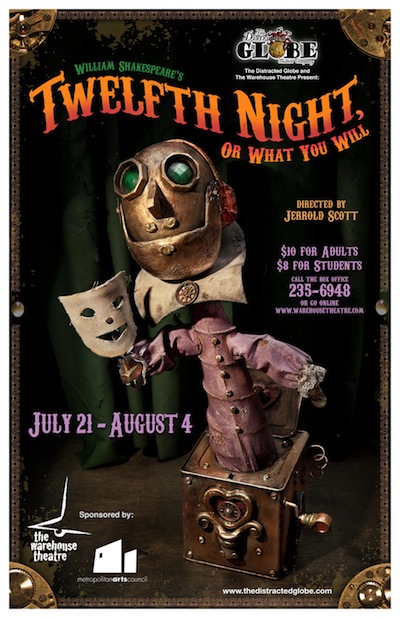
I will tell you a secret. <whisper>I did not want to see this show</whisper>. Life's crazy right now: writing deadlines, two wee kids, a this-old-house-style renovation project. The last production I saw of Twelfth Night was a fool's show. Lotsa gags. Lotsa gas. Lotsa nothin'. Fortunately, the same cannot be said of Jerrold Scott's interpretation that is currently running at The Distracted Globe. It's as thoughtful as it is beautiful--without skimping on the laughs.
First comes laughter. Anne Kelly Tromsness (Maria) and Jayce Tromsness (Sir Toby Belch) offer up richly textured clowns, lovely foils to Rick Connor's hilariously affected Sir Andrew Aguecheek. I don't know when I've laughed so much at a single character as I did last night at Aguecheek. This unlikely trio connives to unseat Countess Olivia's chief steward Malvolio (another clown, a peacocky Puritan, played with fire by Matt Reece).
Then comes the beauty. Elizabeth Gray has designed exquisite Steampunk attire for courtesans and clowns alike. While I was skeptical of this arrangement at first, it does work out quite nicely. In a style that exposes the "inner workings" of people, how apropos that Duke Orsino wears all his gears, cogs, pistons on his shirtsleeve...right where he keeps his feelings. Andy Croston turns in a grand performance as this Duke in love with being in love. His melancholy humors are believable and infectious (a hard sell for the modern audience, but he scores), and when he's opposite his servant Cesario (Heidi Fortune, bravo)--my heart starts racing. Their chemistry is amazing...even if Orsino can't see that Cesario is a woman.
That's the other thing about steampunk: it's obsessed with vision. Virtually everyone in the show (and in steampunk) wears high-powered, ultra perceptive goggles--which sit, unused, atop their hats. Orsino and Olivia can't see that they're in love with the wrong people. Olivia (Miranda Notus) is so blind she could make you scream. Feste (Phyllis Jackson) sees everything and does nothing--though her jail cell scene with Malvolio is quite moving.
And here's where the thought bit comes in. Sure, this may have been written four hundred years ago, but we humans haven't changed a bit. How easily we laugh our way to cruelty. (I mean, who DOESN'T want to humiliate their own personal Malvolio in those yellow stockings....and then lock him in a jail cell until he whimpers? Guilty as charged.) How often we put on a show of loving, when all we really love is pitter-patter. How quickly we disguise our true selves, lying about our essence, especially when love is right under our noses. Ouch. There are some dark thoughts in this play, and they aren't all packed up in a little crate at the end. But fortunately for all those Lords and Ladies (and fortunately for me!) there's a little bit of hope and a lot a bit of love.
--
Three more performances left! Get your tickets
William Shakespeare's "Twelfth Night," directed by Jerrold Scott
Presented by The Distracted Globe at Warehouse Theatre, 37 Augusta St., Greenville (864) 235-6948. Through August 4. Tickets $10.

I must first open this review with an obnoxious: Howdy, Greenville, I'm baaaaaack! Too long pregnant, sick, and on bed rest. Missed all y'all. Now with baby #2, and itching to get back to theatering.
So, first up:
Neil Simon's Lost in Yonkers at Warehouse Theatre. Again I will interrupt this review. Opening weekend: sold out (I couldn't even get a seat!) This weekend: sold out. Next weekend: selling fast. If you already know you want to catch this show (and I think you will), then I recommend you stop reading and go buy your tickets. Now.
The review. Lost in Yonkers is the story of Jay and Arty, two boys who get left with Grannie-from-Hades while Dad goes off in search of work. It's the story of all the things they learn about while dodging her cane: moxie, mustard soup, dark family secrets, love.
The actors playing the boys--Sam Farnsworth (Jay) and Graham Poore (Arty)--ain't too shabby. As my date said, "If you'd told me there were going to be kids in this show, I wouldn't have come. But these guys are good." They're at ease with themselves and each other--so much at ease and playful that I assumed they were brothers in fact. Wrong. Kudos Sam and Graham. You were great, and it's a good thing you learned some moxie, because I wanted to march right up there and protect you from Grandma (Shirley Sarlin, Greenville legend, making another of her legendary appearances.)
And I do mean "another." Ms. Sarlin. I will confess to being frustrated at the thought of seeing you play yet another cute little elderly Jewess (please please please could someone write you a different sort of role?) Wrong again. Elderly. Yes. Jewish. Yes. Cute? Cuss, No! This is the Grandma who locks her kids in the closet and clobbers 'em if they steal "the salt off a pretzel." Ja, und Frau Sarlin, you scared me, you made me mad, you made me very sad. (I guess I should thank you for this?)
I definitely won't be thanking you for how you raised your kids or for the awful awful things you did to them. Rick Connor, you make the best kind of gangster uncle a kid could ever hope for. And Kerrie Seymour...
Kerrie Seymour. You are why people need to see this show. Folks, this girl is heartbreaking. And funny. So transparent and quirky I loved her to bits. I loved her so much I wanted to sew copies of her hideous dresses and wear them around town and tell everybody her story. I wanted to see her win. I wanted her to have an impossibly happiest happy ending.
But Pulitzer Prize-Winning** plays don't have those cliche happy-happy endings. They have mostly-happy endings, where people learn how to deal with what life's dealt: like lameness, family, war, family, debt...family. And that's what makes this play one that sticks with you. All the life-interruptions and mess of the play don't just pouf and disappear. You laugh through it, cry through it, and hopefully, grow right along with the characters.
---
Neil Simon's "Lost In Yonkers"
Presented by Warehouse Theatre, 37 Augusta St., Greenville (864) 235-6948. Through September 10. Tickets $30.
**Pulitzer Prize-Winning plays also tend to be above critique. Please forgive me, I love Mr. Simon's work, but that was one long (dry?) opening scene. And most of the exposition, don't we get that later in the play? Minor quibble, I know, especially for such a wonderful play. If you get antsy in the beginning, just sit tight. The writing (and acting) starts to crackle soon.
What a great title for a review of Centre Stage's Sweeney Todd. I'm glad I thought of it. Unfortunately, that's about all I could come up with, because the title is all too true. I woke up yesterday monstrous ill and had to cancel (sob) my seats for the show. What's worse--every other show time is already booked on my calendar :(
So that's all I have to share with you. Except this recipe for Really Helpful Sick Time Tea. Many of you probably already do honey/lemon tea, but this one has a secret ingredient that I've found to be most helpful.
Really Helpful Sick Time Tea
--Green Tea (I prefer a loose leaf Japanese Sencha--pick some up at the Asian market near you)
--Juice of half a Lemon (it HAS to be from a fresh lemon. That stuff in a plastic bottle DOES NOT work for this).
--Local, Raw Honey. (MUST be local and raw. The pasteurized cooked-to-death stuff at your grocery store will actually make your illness worse.)
And the secret ingredient?
--A dash of cloves.
--Oh, and of course, boiling water.
Easy, helpful, and much more yummier than "Honegar with a Sprinkling of Cayenne Pepper" (hoooie! trust me on that one). It's good for what ails you--unless what ails you is not being able to see Sweeney Todd because you waited too long for tickets. So don't wait.
As my friend yesterday so helpfully put it, "It's the greatest play that's ever played" and you've not seen it yet?!?! Ever?!?!? No, friend. I haven't (ah-ah-ah-choo!)
So do yourself a favor. Drink lots of healthy beverages, snap up some tickets, and go be sickened by the "Demon Barber of Fleet Street."
DISCLAIMER:
I am not a doctor any more than Sweeney Todd is a barber. This recipe may not be as lethal as a visit to Mr. Todd, but then again, it just might be. Be it on your own head if you attempt this brew and fail to consult a medical doctor for any ailments from which you may be suffering.
There. I'm done. (Sniffle). Let me know how the play played.
 Once upon a time, we told myths to explore the world and our place in it. But then we grew cleverer and faster than our ancestors. We invented Science. Now we know about evolution and pi and the square roots of all kinds of Very Important Numbers. We know how to harness nuclear power so that we can make more energy so that we can own more stuff so that we can be happier or at least kill the people who make us unhappy. Myths? They were all about useless, unquantifiable, irrational stuff like love. Totally untrustworthy; who needs 'em?
I do, for one. And I suspect you do, too. Science and rationalism can't answer every human need, but it seems that's all we've got these days (that, or piddling little "stories" designed to make us all buy the same products to look the same way to be happy or at least ignore the people who don't buy the same product and therefore make us unhappy). If you, like me, are strung out on schedules and stats and need a heaping dose of humanity, then I propose that Warehouse Theatre's season opener is just the magic the gods ordered. Walk, run, swim, FLY to see Metamorphoses. This gorgeous production is more than a crash course in Greek mythology; it's about what it means to walk on this earth with other people. I'd wager it's the most important (and startling) play of Greenville's 2011/2012 theatre season.
And if you don't care about any of that irrational humanity gobbledy-gook? Let me give you some cold hard facts to prove that you (even you!) should hie you to the nearest phone (or e-mail client) and order up some tickets.
1. The whole play takes place IN A POOL. Which, as you know, cost lots and lots and lots of money to build. And as you know, more money = more better. So there you have it. (Of course, being in a pool also makes the play astonishingly beautiful. If you care about such things.)
2. Even if you've never peeked at the Greeks in your life, money couldn't buy you a better tour guide. Shannon Robert (director) takes care to ease us into the irrationality of this new-old world. The opening scenes are reigned in, clearly articulated, and paced slowly enough that our ears can adjust to these strange cadences. (Of course, once we're acclimated, Robert plunges us head-first into the disorienting ether of Ovid. Staging becomes more and more erratic and bizarre. It's brilliant, really.)
3. I know we don't have Oscars in Greenville, but if you want to see really good acting (really, really good), skip the movies and see this show. Again, wait for things to warm up. In the beginning, the actors are just helping you along. But once they've got you where they want you, pow! There's a knockout performance by . . . well, just about everyone in this eleven person cast. I think I'll just list Melissa Peters for her disturbing (and disturbingly sympathetic) Myrrha. But then I remember all the times Jason D. Johnson and Jason M. Shipman made me laugh, and how well they inhabited each of their roles with such distinction and clarity. And how Matthew Merritt and Debra Capps kept making me cry. And how . . . 'Nough said.
4. I will now quote to you from an esteemed Therapist, skilled in diagnosing all of our modern problems by scientifically proven methods learned at an expensive school. (Of course, it's the therapist from Metamorphoses, but that shouldn't matter, should it?) "Myths are the earliest forms of science . . . Unfortunately we give our mythic side scant attention these days. As a result, a great deal escapes us and we no longer understand our own actions. So it remains important and salutary to speak not only of the rational and easily understood, but also of enigmatic things: the irrational and the ambiguous. To speak both privately and publicly."
--Mary Zimmerman's Metamorphoses. Now playing at Warehouse Theatre. Do Not Miss It.
PS. A note to parents: Esther Williams this is not. This is Ovid--you know, that old Greek guy who is still banned from a lot of classrooms for being, ahem, "inappropriate." Please leave the wee swimmers at home.
--
Mary Zimmerman's "Metamorphoses"
Presented by Warehouse Theatre, 37 Augusta St., Greenville (864) 235-6948. Through September 10. Tickets $25.
 There are three types of people in this city of ours:
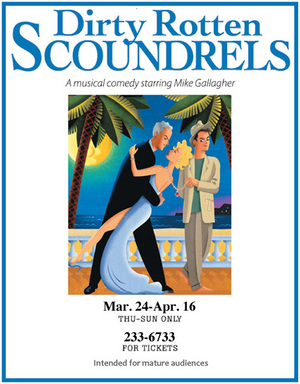
1. Those who hear "Dirty Rotten Scoundrels the Musical starring a FOX News celebrity" and run straight to the theatre without even asking which FOX News celebrity.
2. Those who, upon hearing the word "musical," run-dash-sprint! in the opposite direction.
3. Those who are morbidly curious. Can such a thing be done? A musical? Dirty Rotten Scoundrels? Really? And so we (yes, I am of this third category)--we pick up our tickets with trepidation.
If you're in the first or second category, I'm not even going to talk to you. You've already made up your mind, and judging from the Center Stage's production, you'll be ecstatic if you just stay your course. The musical-y inclined will thrill at the set! the dancing! quick costuming! laughing! The runners-away will shudder at such sections as (I'm not making this up) "Let's All Yodel." Stay your course.
But what about those curious among us? Here are the observations of one trepidatious (not a word) theatre-goer.
1. The lyrics are brilliantly clever, hilarious in spaces (when asked to describe the magic of being alive, Freddy lists such things as: "my hotel gives away free shampOOOOO"). The book also sometimes bowls you right over (Especially when discussing the glories of Wagner and bacon....) If you at all like word-play, reparte--go! Lane and Yazbek have cooked up such a feast as will not disappoint.
2. Some of the scenes are hysterical. "All About Ruprecht" is one of the funniest things I've seen this season. Todd Weir's Freddy Benson is perfect here--the faux "disturbed" brother may have run off Lawrence's unwanted fiance, but he's enough to drag the audience back for a second round of laughs. If you love to laugh--go. (Just save your drinks till intermission....)
3. If you just want to see if this Dirty Rotten Scoundrels worked as a musical? Eh. Maybe you should join up with some of those runners away.
3. a. Choreography. In trying to wow us with Musical-ity, the Choreographers That Be crammed the space with more chorus girls that you can shake a stick at. The resulting dance sequences (of which there are plenty) went limp. I will say, that when the number of dancing dames was severely limited--such as in "The More We Dance" the relatively simple choreography became electric. The dancers had freedom to move, to be energetic, and I was delightfully entranced.
3. b. Music. There were some songs that really worked: those whose lyrics were too clever not to work ("All About Ruprecht"), and those that were an outright parody of the musical form ("Love is My Legs" was one hysterical example). In both cases, the performers truly inhabited the music and had the audience doubled over in laughter. I wished for (but could not find) the same let-loose sincerity from the other musical numbers.
I would like to note that there were some strong performances (Todd Weir's Freddy Benson I've already mentioned). Melanie Ann Wiliford was refreshingly in command of her Muriel Eubanks, and more: her singing had the note of truth, whether she was being funny or no. Hers was an intelligent, stable performance, and I'm glad I saw it.
Runners to the theatre--I hope you still run, and run fast. You will have a blast. Runners away, you have been warned. Wonderers? Now that's up to you.
Regardless of your thoughts on the Black History Month (and the fact that it happens to occupy the shortest month of the year)--JDew's "One Voice" at Warehouse Theatre is almost as moving a sweep through famous Black Americans (and Greenvillians) as one could hope for.
JDew (this is a solo show) handles each character with just the right amounts of restraint and rage and hope. He builds his material to a fevered climax. Shivery vocals by Valisa Smith, a tearful interview with Greenville's Wilfred J. Walker, Sr., followed by Martin Luther King, Jr. and his dream. JDew has done his job perfectly--the audience is strained to the heights. We're waiting for that long-promised Justice to roll down.
And then! And then! It never does. Not that there hasn't been any notable history after King, but that there isn't any more in the show. Instead, there comes a baffling interlude. Right when those mighty waters are about to break, in comes Cassius Clay. And not the Cassius Clay/Muhammad Ali of renowned political activism ("Why should they ask me to put on a uniform and go ten thousand miles from home and drop bombs and bullets on brown people in Vietnam while so-called Negro people in Louisville are treated like dogs and denied simple human rights?"), but the clowinish Clay of early days. And even more unfortunately, the same is true for the following act: Bill Cosby in all his humorous glory, not the Bill Cosby who is still speaking hard to the racial problems of the day.
Don't get me wrong: there's nothing wrong with the performance. JDew hilariously embodies both men, and the audience is more than ready for a laughing break. Still, I couldn't help but wonder what happened to that longing for justice? For the longing that JDew stirred up and whipped to a frenzy? Where did all that fevered emotion go? What on earth happened between '68 and 2008--when JDew again picks up his threads of oppression and redemption with Obama's "Yes We Can." Don't tell me all we did was laugh. Something happened in those forty years between one man's assassination and another man's election.
Despite it's little foibles, this is still a show worth seeing--in its current incarnation and (I hope) in a more carefully structured version some time in the future. And while I am hoping, let me also hope that someday soon JDew's show will not have to be limited to that narrow window of time we call "Black History Month," but that it will be viewed with as much enthusiasm and interest all the other months of the year.
--
JDew's "One Voice" Directed by Ron Pyle.
Presented by Warehouse Theatre, 37 Augusta St., Greenville (864) 235-6948.