
Wake up. Hug your kids. Check your hand to see if the bite marks have faded. Squeeze your kids tight. Cry. Wander around the house--what do you write about one of the worst experiences of your life? Are the teeth marks really gone?
Forgive the scattery review. Shannon Robert led The Clemson Players in such a show as I could only watch by nearly chewing my hand off. Here are my brief notes and what thoughts I can remember from before the hand-gnawing began.
-That set (also by Shannon Robert)! Chilling and forbidding, the classic Greek stone seems beautiful, inevitable. And that bench tucked away over there led to some breathtaking staging.
-Meredith Kidd (Nurse) gave us modern-ers an introduction we could both understand and get worked up about. The Greeks ain't easy, but she made that passion seem normal!
-I love this translation (McLeish and Raphael)--easy to understand, and still muscular. Check to see if they've done any other Greeks.
-Hunter Spangler was such a natural self-assured Jason--I both loved and hated him. Was he telling the truth about his motivation for the new wife? I could almost buy it--seriously. In Greek society, was he doing the right thing? There lies the conundrum of the play.
-Medea, the spurned wife. Lauren French. Tough part for a girl so young, but she sunk her teeth into the rage and grief and shook. Lost a little grounding in the quieter moments, but you could hardly blame her for that, when the rage was so real. Would dearly love to see her tackle this role again in ten or twenty years.
-Tony Pena's lighting--especially on Medea, especially in her torment, wow.
-The Chorus. Perhaps the most foreign element of a Greek play. If the thought of a chorus has kept you away from the Greeks, this is the play to change your mind. These girls were lythe, slithering, stomping, punctuating, pushing--the glue that held the show together. Excellent direction & stage picture. In my mind, these girls are the reason to see this show. And they're the reason I still have any hand left.
Let me tell you about it.
No spoilers here--the very first scene of the play tells you what you need to know: Medea's gonna kill her two little boys. But, being human, you hope and hope it isn't going to happen. It's like a friend I had in high school--big guy, jock--used to watch Anne of Green Gables over and over again because "I keep hoping that this time, Matthew won't die. And he does every time. And I cry."
I'm a big girl. I'm also a theatre person, and I know the story of Medea. I know how know that in Greek tragedies, all the awful stuff happens off stage. But I also have two boys. One of whom is the age of the little ones on stage. When Medea goes ballistic, and runs off stage to...(I can't even write it without struggling to breathe)
There are sounds.
The chorus, wailing.
Children, screaming.
Screaming.
I sink my teeth into my hand--hard as I can. Don't scream. Bite. Don't sob. Bite. Don't sob! Bite! Don't run from the theatre. Don't run on stage to stop it.
In a truly Greek fashion, my eyes are faucets; I never knew so much could pour out of them at once. I have never felt this sort of fear before in my life. I need to run I need to stop Those sounds Those kids BITE.
The chorus writhing in agony. Mourning. Yes. Yes, it's over. They're mourning now. You can cry, just cry. But it's not over. The damned deed is not done. That was just the first child. There is more. The sounds are back, and worse.
The morning after, I have a hard time processing these emotions. I do know: I am angry. I trust theatre to take care of me. I know it will throw me around, give me an emotional journey like no other, but in the end, I trust the people in the theatre to take care of me. Last night was the first time I felt unmoored at a show. I felt betrayed. Okay, so there was actual terror, fine; I don't like it, but I'll go there with you. But to give me hope that it was over? To tell me it was okay, and then to make my heart do that exploding thing again? Yes, I am angry.
Now my "rational" side knows that if ever a show should make us angry, it should be Medea, that if I had another week to think on this review maybe I could come up with some great insight about how Medea should unmoor us and how everyone should go and be unmoored for a moment. This is a part of humanity. Much as we want to claim all goodness and light, this is an ugly part of us and we must own it. But I'm a mommy. And those were kids. I couldn't help, of course, thinking of Sandy Hook and child soldiers and all the other wars waged on children. I couldn't help but feel a need to run out in the streets and hug every kid I could find.
I want to draw this to a tidy conclusion, like the Greeks. Some lesson about the gods, and how you can make your plans but the gods know better. But that doesn't feel right. It certainly doesn't help me, or you, when you're shaken to the core and you don't honestly know why. So no lessons. No conclusions. Just this: take someone with you. Someone you can hug. 'Cause you're both going to need it.
--
Euripides' "Medea," translated by Kenneth McLeish and Frederic Raphael. Presented by The Clemson Players and directed by Shannon Robert. Through March 2. Tickets $15, $10 for students.
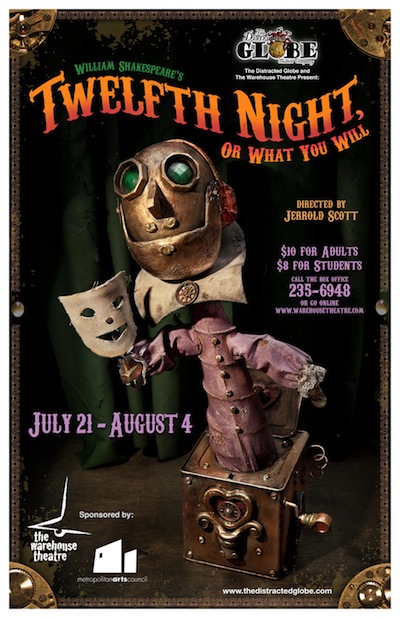
I will tell you a secret. <whisper>I did not want to see this show</whisper>. Life's crazy right now: writing deadlines, two wee kids, a this-old-house-style renovation project. The last production I saw of Twelfth Night was a fool's show. Lotsa gags. Lotsa gas. Lotsa nothin'. Fortunately, the same cannot be said of Jerrold Scott's interpretation that is currently running at The Distracted Globe. It's as thoughtful as it is beautiful--without skimping on the laughs.
First comes laughter. Anne Kelly Tromsness (Maria) and Jayce Tromsness (Sir Toby Belch) offer up richly textured clowns, lovely foils to Rick Connor's hilariously affected Sir Andrew Aguecheek. I don't know when I've laughed so much at a single character as I did last night at Aguecheek. This unlikely trio connives to unseat Countess Olivia's chief steward Malvolio (another clown, a peacocky Puritan, played with fire by Matt Reece).
Then comes the beauty. Elizabeth Gray has designed exquisite Steampunk attire for courtesans and clowns alike. While I was skeptical of this arrangement at first, it does work out quite nicely. In a style that exposes the "inner workings" of people, how apropos that Duke Orsino wears all his gears, cogs, pistons on his shirtsleeve...right where he keeps his feelings. Andy Croston turns in a grand performance as this Duke in love with being in love. His melancholy humors are believable and infectious (a hard sell for the modern audience, but he scores), and when he's opposite his servant Cesario (Heidi Fortune, bravo)--my heart starts racing. Their chemistry is amazing...even if Orsino can't see that Cesario is a woman.
That's the other thing about steampunk: it's obsessed with vision. Virtually everyone in the show (and in steampunk) wears high-powered, ultra perceptive goggles--which sit, unused, atop their hats. Orsino and Olivia can't see that they're in love with the wrong people. Olivia (Miranda Notus) is so blind she could make you scream. Feste (Phyllis Jackson) sees everything and does nothing--though her jail cell scene with Malvolio is quite moving.
And here's where the thought bit comes in. Sure, this may have been written four hundred years ago, but we humans haven't changed a bit. How easily we laugh our way to cruelty. (I mean, who DOESN'T want to humiliate their own personal Malvolio in those yellow stockings....and then lock him in a jail cell until he whimpers? Guilty as charged.) How often we put on a show of loving, when all we really love is pitter-patter. How quickly we disguise our true selves, lying about our essence, especially when love is right under our noses. Ouch. There are some dark thoughts in this play, and they aren't all packed up in a little crate at the end. But fortunately for all those Lords and Ladies (and fortunately for me!) there's a little bit of hope and a lot a bit of love.
--
Three more performances left! Get your tickets
William Shakespeare's "Twelfth Night," directed by Jerrold Scott
Presented by The Distracted Globe at Warehouse Theatre, 37 Augusta St., Greenville (864) 235-6948. Through August 4. Tickets $10.
What a great title for a review of Centre Stage's Sweeney Todd. I'm glad I thought of it. Unfortunately, that's about all I could come up with, because the title is all too true. I woke up yesterday monstrous ill and had to cancel (sob) my seats for the show. What's worse--every other show time is already booked on my calendar :(
So that's all I have to share with you. Except this recipe for Really Helpful Sick Time Tea. Many of you probably already do honey/lemon tea, but this one has a secret ingredient that I've found to be most helpful.
Really Helpful Sick Time Tea
--Green Tea (I prefer a loose leaf Japanese Sencha--pick some up at the Asian market near you)
--Juice of half a Lemon (it HAS to be from a fresh lemon. That stuff in a plastic bottle DOES NOT work for this).
--Local, Raw Honey. (MUST be local and raw. The pasteurized cooked-to-death stuff at your grocery store will actually make your illness worse.)
And the secret ingredient?
--A dash of cloves.
--Oh, and of course, boiling water.
Easy, helpful, and much more yummier than "Honegar with a Sprinkling of Cayenne Pepper" (hoooie! trust me on that one). It's good for what ails you--unless what ails you is not being able to see Sweeney Todd because you waited too long for tickets. So don't wait.
As my friend yesterday so helpfully put it, "It's the greatest play that's ever played" and you've not seen it yet?!?! Ever?!?!? No, friend. I haven't (ah-ah-ah-choo!)
So do yourself a favor. Drink lots of healthy beverages, snap up some tickets, and go be sickened by the "Demon Barber of Fleet Street."
DISCLAIMER:
I am not a doctor any more than Sweeney Todd is a barber. This recipe may not be as lethal as a visit to Mr. Todd, but then again, it just might be. Be it on your own head if you attempt this brew and fail to consult a medical doctor for any ailments from which you may be suffering.
There. I'm done. (Sniffle). Let me know how the play played.
 Once upon a time, we told myths to explore the world and our place in it. But then we grew cleverer and faster than our ancestors. We invented Science. Now we know about evolution and pi and the square roots of all kinds of Very Important Numbers. We know how to harness nuclear power so that we can make more energy so that we can own more stuff so that we can be happier or at least kill the people who make us unhappy. Myths? They were all about useless, unquantifiable, irrational stuff like love. Totally untrustworthy; who needs 'em?
I do, for one. And I suspect you do, too. Science and rationalism can't answer every human need, but it seems that's all we've got these days (that, or piddling little "stories" designed to make us all buy the same products to look the same way to be happy or at least ignore the people who don't buy the same product and therefore make us unhappy). If you, like me, are strung out on schedules and stats and need a heaping dose of humanity, then I propose that Warehouse Theatre's season opener is just the magic the gods ordered. Walk, run, swim, FLY to see Metamorphoses. This gorgeous production is more than a crash course in Greek mythology; it's about what it means to walk on this earth with other people. I'd wager it's the most important (and startling) play of Greenville's 2011/2012 theatre season.
And if you don't care about any of that irrational humanity gobbledy-gook? Let me give you some cold hard facts to prove that you (even you!) should hie you to the nearest phone (or e-mail client) and order up some tickets.
1. The whole play takes place IN A POOL. Which, as you know, cost lots and lots and lots of money to build. And as you know, more money = more better. So there you have it. (Of course, being in a pool also makes the play astonishingly beautiful. If you care about such things.)
2. Even if you've never peeked at the Greeks in your life, money couldn't buy you a better tour guide. Shannon Robert (director) takes care to ease us into the irrationality of this new-old world. The opening scenes are reigned in, clearly articulated, and paced slowly enough that our ears can adjust to these strange cadences. (Of course, once we're acclimated, Robert plunges us head-first into the disorienting ether of Ovid. Staging becomes more and more erratic and bizarre. It's brilliant, really.)
3. I know we don't have Oscars in Greenville, but if you want to see really good acting (really, really good), skip the movies and see this show. Again, wait for things to warm up. In the beginning, the actors are just helping you along. But once they've got you where they want you, pow! There's a knockout performance by . . . well, just about everyone in this eleven person cast. I think I'll just list Melissa Peters for her disturbing (and disturbingly sympathetic) Myrrha. But then I remember all the times Jason D. Johnson and Jason M. Shipman made me laugh, and how well they inhabited each of their roles with such distinction and clarity. And how Matthew Merritt and Debra Capps kept making me cry. And how . . . 'Nough said.
4. I will now quote to you from an esteemed Therapist, skilled in diagnosing all of our modern problems by scientifically proven methods learned at an expensive school. (Of course, it's the therapist from Metamorphoses, but that shouldn't matter, should it?) "Myths are the earliest forms of science . . . Unfortunately we give our mythic side scant attention these days. As a result, a great deal escapes us and we no longer understand our own actions. So it remains important and salutary to speak not only of the rational and easily understood, but also of enigmatic things: the irrational and the ambiguous. To speak both privately and publicly."
--Mary Zimmerman's Metamorphoses. Now playing at Warehouse Theatre. Do Not Miss It.
PS. A note to parents: Esther Williams this is not. This is Ovid--you know, that old Greek guy who is still banned from a lot of classrooms for being, ahem, "inappropriate." Please leave the wee swimmers at home.
--
Mary Zimmerman's "Metamorphoses"
Presented by Warehouse Theatre, 37 Augusta St., Greenville (864) 235-6948. Through September 10. Tickets $25.
 There are three types of people in this city of ours:
1. Those who hear "Dirty Rotten Scoundrels the Musical starring a FOX News celebrity" and run straight to the theatre without even asking which FOX News celebrity.
2. Those who, upon hearing the word "musical," run-dash-sprint! in the opposite direction.
3. Those who are morbidly curious. Can such a thing be done? A musical? Dirty Rotten Scoundrels? Really? And so we (yes, I am of this third category)--we pick up our tickets with trepidation.
If you're in the first or second category, I'm not even going to talk to you. You've already made up your mind, and judging from the Center Stage's production, you'll be ecstatic if you just stay your course. The musical-y inclined will thrill at the set! the dancing! quick costuming! laughing! The runners-away will shudder at such sections as (I'm not making this up) "Let's All Yodel." Stay your course.
But what about those curious among us? Here are the observations of one trepidatious (not a word) theatre-goer.
1. The lyrics are brilliantly clever, hilarious in spaces (when asked to describe the magic of being alive, Freddy lists such things as: "my hotel gives away free shampOOOOO"). The book also sometimes bowls you right over (Especially when discussing the glories of Wagner and bacon....) If you at all like word-play, reparte--go! Lane and Yazbek have cooked up such a feast as will not disappoint.
2. Some of the scenes are hysterical. "All About Ruprecht" is one of the funniest things I've seen this season. Todd Weir's Freddy Benson is perfect here--the faux "disturbed" brother may have run off Lawrence's unwanted fiance, but he's enough to drag the audience back for a second round of laughs. If you love to laugh--go. (Just save your drinks till intermission....)
3. If you just want to see if this Dirty Rotten Scoundrels worked as a musical? Eh. Maybe you should join up with some of those runners away.
3. a. Choreography. In trying to wow us with Musical-ity, the Choreographers That Be crammed the space with more chorus girls that you can shake a stick at. The resulting dance sequences (of which there are plenty) went limp. I will say, that when the number of dancing dames was severely limited--such as in "The More We Dance" the relatively simple choreography became electric. The dancers had freedom to move, to be energetic, and I was delightfully entranced.
3. b. Music. There were some songs that really worked: those whose lyrics were too clever not to work ("All About Ruprecht"), and those that were an outright parody of the musical form ("Love is My Legs" was one hysterical example). In both cases, the performers truly inhabited the music and had the audience doubled over in laughter. I wished for (but could not find) the same let-loose sincerity from the other musical numbers.
I would like to note that there were some strong performances (Todd Weir's Freddy Benson I've already mentioned). Melanie Ann Wiliford was refreshingly in command of her Muriel Eubanks, and more: her singing had the note of truth, whether she was being funny or no. Hers was an intelligent, stable performance, and I'm glad I saw it.
Runners to the theatre--I hope you still run, and run fast. You will have a blast. Runners away, you have been warned. Wonderers? Now that's up to you.
Regardless of your thoughts on the Black History Month (and the fact that it happens to occupy the shortest month of the year)--JDew's "One Voice" at Warehouse Theatre is almost as moving a sweep through famous Black Americans (and Greenvillians) as one could hope for.
JDew (this is a solo show) handles each character with just the right amounts of restraint and rage and hope. He builds his material to a fevered climax. Shivery vocals by Valisa Smith, a tearful interview with Greenville's Wilfred J. Walker, Sr., followed by Martin Luther King, Jr. and his dream. JDew has done his job perfectly--the audience is strained to the heights. We're waiting for that long-promised Justice to roll down.
And then! And then! It never does. Not that there hasn't been any notable history after King, but that there isn't any more in the show. Instead, there comes a baffling interlude. Right when those mighty waters are about to break, in comes Cassius Clay. And not the Cassius Clay/Muhammad Ali of renowned political activism ("Why should they ask me to put on a uniform and go ten thousand miles from home and drop bombs and bullets on brown people in Vietnam while so-called Negro people in Louisville are treated like dogs and denied simple human rights?"), but the clowinish Clay of early days. And even more unfortunately, the same is true for the following act: Bill Cosby in all his humorous glory, not the Bill Cosby who is still speaking hard to the racial problems of the day.
Don't get me wrong: there's nothing wrong with the performance. JDew hilariously embodies both men, and the audience is more than ready for a laughing break. Still, I couldn't help but wonder what happened to that longing for justice? For the longing that JDew stirred up and whipped to a frenzy? Where did all that fevered emotion go? What on earth happened between '68 and 2008--when JDew again picks up his threads of oppression and redemption with Obama's "Yes We Can." Don't tell me all we did was laugh. Something happened in those forty years between one man's assassination and another man's election.
Despite it's little foibles, this is still a show worth seeing--in its current incarnation and (I hope) in a more carefully structured version some time in the future. And while I am hoping, let me also hope that someday soon JDew's show will not have to be limited to that narrow window of time we call "Black History Month," but that it will be viewed with as much enthusiasm and interest all the other months of the year.
--
JDew's "One Voice" Directed by Ron Pyle.
Presented by Warehouse Theatre, 37 Augusta St., Greenville (864) 235-6948.
 In keeping with the spirit of Edward Albee's "Who's Afraid of Virginia Woolf?" let me begin this review by being awkwardly personal. I've spent the last two weeks in a dark place (artistically, spiritually, practically, relationally, every-ally). So when time comes 'round to review Warehouse Theatre's latest offering, here was my gut reaction: "I really don't want to spend three hours in a room with people screaming obscenities at each other." My beleaguered husband's gut reaction was "Maybe you should call in sick for this one." Dark places or no, maybe this is also your inclination regarding such painful masterpieces of the theatre: Why on earth should I watch people lacerate each other?
Now let me borrow another convention from the play: erudition. The Greeks had a handy concept for why these stories are important. It's called catharsis, and I think it works something like this (correct me, George, if I'm wrong).
1. You go to Warehouse Theatre, and you watch Mimi Wyche be one witch of a woman as Martha. You can't help but watch her. Wyche's work is like fire--entrancing, beautiful, and sickeningly destructive. (If you've only got the fortitude to see one Martha before you die, you'd do well to pick Wyche's.)
2. You feel her husband George (played by Chip Egan) sink deeper and deeper into the bogs of his dead-end middle-aged nightmare. Thanks to Egan's raw, natural performance, you feel yourself slipping into that slew as well.
3. You watch them air their dirtiest secrets, tear at each other's most tender places, and generally destroy each other in front of two complete strangers, Nick (Brock Koonce) and Honey (Debra Capps), both of whom get singed in the fire, and both of whom know how to occupy the right amount of space in the story. Capps is charming and frail; Koonce is bullish and condescending; neither try to wrest your attention from the real fire between George and Martha.
4. You enjoy director Roy Fluhrer's masterful pacing, and (no thanks to the Greeks) you take breaks, called intermissions. All of this helps you survive the fire.
5. Then you see them all burn up: George, Martha, all their pretenses, and all the little illusions they've created in order to survive.
6. And you could have a miniature light-bulb moment, say, "Hey, I don't have it that bad," feel better about your life, and move on until the next flavor of existential crisis blah strikes your fancy.
7. Or, you cold have genuine (Greek) pity for the characters, the people around you, yourself. You might even be able to recognize and confront some of your own fear-filled illusions, and step forward with George and Martha into something that isn't radiant and isn't perfect, but just might be a little bit more truthful.
That ending is one of the most truthful moments I've scene in a theatre in a long time, and it's worth every bit of agony to get there. It's not easy. It hurts. But it is (as so few things are) truly vital. Darkness or no, I'm especially glad I didn't call in sick.
--
Edward Albee's "Who's Afraid of Virginia Woolf?"
Presented by Warehouse Theatre, 37 Augusta St., Greenville (864) 235-6948. Through February 5. Tickets $25.
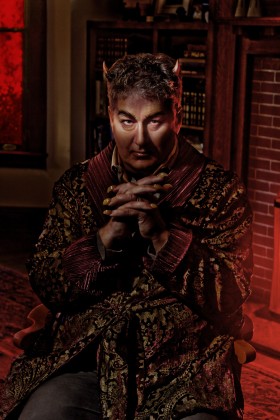 If you don't know the story, it goes something like this (no spoilers, I promise): Wormwood, neophyte fiend and demon tormentor, gets his first job stealing Mike's soul. But being such a dunce at the whole evil-devil-thing, he needs uncle Screwtape to give advice. Lots of advice. Too much advice? Controlling? While it may not be your Grandmother's C.S. Lewis, Warehouse Theatre's, Screwtape still offers plenty to chew on. (And no, I'm not talking about the oft-threatened feast of defunct demons.)
Let's start with the adaptation, which appears to be an interesting contortionist exercise by James Forsyth. The script almost seems a reaction against demon Screwtape's (in)famously arrogant pontifications. Forsyth has cast-off the epistolary structure in favor of forcing a rather castrated Screwtape to bungle his way through the "adventures" alongside his nephew Wormwood. The result is a script that can't seem to decide where (or how) to cast its fiendish gaze. It's not satirical. It's not absurd. It's definitely not real. It's . . . ?
This is not to say anything against the actors charged with playing these conflicted roles, or the fantastic designers. Shannon Robert turns in a fun and functional set worthy of Wonderland's rabbit hole. April Schaeffer deserves double applause, both for the show's electric choreography (these sections spoke more to Lewis' point than most of Forsyth's text--I found myself wishing for an entirely dance-based riff on Screwtape) and for her own beautifully stylized Milly. Roberta Barnes (Slumtrimpet the demon sexpert) and Michele Labar (Mike's [s]Mother) followed suit with their own hyperbolic performances.
Jason Adkins provides a disconcertingly normal (disillusioned, often discouraged) chap for the devils to torment, and Tara Sweeney excels in a particularly difficult role--one that could have easily run into a saintly sweet and surface-y lampoon. Instead, her overtly Christian Judy comes off as refreshingly complete. And one last brief note of kudos to Miranda Notus: the small character Queenie who absolutely commanded her scene and my attention. I hope to see more from her soon.
Then of course, we have the demons. Screwtape (Kevin Treu) and Wormwood (Daryl Ward Phillipy). Both exerted tremendous force and energy on the text and on their "patient." Phillipy even pulled off some grand laughs. But unfortunately for the poor devils, I think the adaptation lacked an essential verve, a vital energy, of belief. At every turn the text undercuts the spirits (incompetent fools), and steals the heart of what could be two delicious villains. I mean, we all know, wink, wink, that devils aren't real. Right? Well, at least for the space of an evening, let us feel their full and fallen glory.
And as for Lewis' theology--well, I'll let the seminary students duke it out on that one. Did or didn't Forsythe remain true to Lewis' doctrine of the soul? Your answer will depend on two things: just how closely you attend to the surprise ending(s), and how much trust you (foolishly?) put in the original Screwtape as a reliable narrator of his own tail. Uhm...tale.
--
James Forsyth's "Screwtape," adaptated from C.S. Lewis' The Screwtape Letters
Presented by Warehouse Theatre, 37 Augusta St., Greenville (864) 235-6948. Through December 18. Tickets $25. Students $15.
Lala Levy would love to be Scarlet O'Hara. Or write about her. Or at least watch her at the movies all day long. Lala's family would just like her to find someone to take her to Ballyhoo--the premier social event for Who's Who among the Southern Jews in 1939. What nobody wants is for a stranger from New York to upset their whole family with prickly issues of racism among their own. Alfred Uhry's "The Last Night of Ballyhoo" at Centre Stage is a hilarious look at how we all, no matter the race, discriminate against each other.
And since we're discriminating, I have to confess to some myself: The men are far and away the treat of this production. Straight man, heartthrob, and deliciously exaggerated scoundrel, they are all a delight to watch. Peter Haloulos plays the charming and ever put-upon Adolph Freitag--an elderly gentleman living with his two sisters and two nieces. His performance is lovable and true. Chris Cashon is completely beguiling as Joe Farkas, the stranger in their midst, "the other kind" of Jew, and Matthew Merritt plays such a believably affected rapscallion (Peach Weil, the blue-blood Jew of Louisiana) that you can't help but fall in love with him.
Among the women, Kelly Wallace consistently kept the laughs coming for her airy and charming Reba Freitag. And as for the rest, make no mistake, each came into her charming own in the second half of the play. Unfortunately for the actresses, Uhry charges his women with bearing large swaths of exposition and introduction in the first half of the show--exposition that hadn't quite found its way into the heart. But post-intermission, when all that back-story was out of the way and we knew who went with whom and why and what exactly was the matter with the odd duck Lala and the family mattress business and relations for two generations back, then the actresses found their cores and gave the men a run for their money (literally--lavish ball gowns, fits of hysteria and fainting, expensive deserts, and why on earth it is that women always go to the bathroom in groups).
Of course it's deeper than that, since what we're laughing about are issues of division, discrimination, cultural identity, war. But Uhry woos us with so much humor (who can't laugh at the delectable "Gone With the Wind" jokes? Or the age-old Christmas/Hanukkah quips?) that we find ourselves laughing to a broader compassion for our fellow men (and women).
So here's my advice to you. Grab someone you love (take a lesson from Boo Levy, and let nothing stop you), grab some tickets, and luxuriate in Rick Connor's comforting set. Listen well in the first half, laugh and laugh (and learn a little), and look forward to a little holiday romance with your special someone.
--
Alfred Uhry's "The Last Night of Ballyhoo" Directed by Chip Egan. Set: Rick Connor.
Presented by Centre Stage, 501 River Street, Greenville, SC (864) 233-6733. Through December 18. Tickets $25, with discounts for seniors and students.
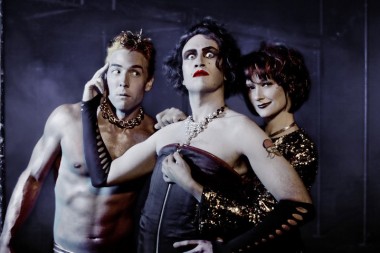 The Rocky Horror Show is a cult classic about this woman named Janet...and this guy named Brad...whose car breaks down outside Dr. Frank 'N' Furter's castle, where sexual treats (and feats) of every flavor are on display. All the time. And they sing. A lot.
Other than that, I really couldn't tell you much about the plot. This morning found me on Wikipedia trying to locate the actual story of the show--some of the major plot elements got a bit muddled in the frenzy o' flesh and the ending made absolutely no sense (Deus ex machina, anyone?), until Wikipedia filled in the pieces for me. So that's who Frank was. I somehow missed that revelation (and more than a few others). Duh.
But this is a cult classic. And nobody goes to a cult classic to actually watch the show. Or think. They go to yell at the actors and dance in the aisles, sing along, throw stuff. Warehouse theatre even sells "audience participation" goodie bags and offers a free lesson in how to join in the actual script of the show (which the audience did, with great glee!) So don't worry about the story, as the narrator will tell you, it doesn't really mean anything anyway.
Just don't tell that to the actors, who've put in some riveting performances (I mean, it's rather impossible NOT to pay attention when 16 people are getting it on, but there were some gorgeous performances nevertheless).
My first shock of the evening was Matthew Merritt's Riff-Raff. While his posturing blended into the overall production, Meritt's vocals were absolutely shiver-inducing. I kept waiting for him to come back and sing just one more song, or part of a song? Please?
And Will Ragland as Frank 'N' Furter. Beautiful. Ragland is mesmerizing, both as a singer and as a performer. The man can strut, he can stroke a note up and down, and he can take the audience wherever he wants to go. And did I mention beautiful? I couldn't help but fall in love with Ragland's electric charisma.
I just wish the playwright had more fully developed Frank's powerhouse character and story. His glam-sex-rock-fest-castle is everywhere (all the time) loudly celebrated, but even this gleeful show couldn't help nodding to the costs of perpetual orgasm. Dr. Frank's bloody rage and his casual disregard for the happiness (or actual lives) of other people crept into the edges of the play and undermined the show's premise (and promise) of an unending free-for-all paradise. But because it was only a nod, a brief look in the meat locker, or a wink at one man's insatiability before we're off into another burlesque, it also undermined the show's ostensibly tragic ending.
Frank 'N' Furter has no tragic flaw--at least not according to the tenor of the show--and his downfall can only be blamed on intolerant, selfish beings, or maybe fate (in the form of an accepted world order), if you stretch for it. So party hard, screw everyone you meet (literally and figuratively) 'cause it's all gonna end (and it won't be your fault, 'cause you're a diva, darling, and nobody really wanted all those pesky limbs or fiances or hearts anyway). Oh, and P.S. there is no meaning in life.
Satisfying? Not really. At least not as a story--nor as a convincing argument for sexual liberation. But as a heaping dose of voyeuristic titillation with Master Frank? Perhaps I should have followed the instructions printed in my program: "If you've never had the Rocky experience, hold on to your seats (you might need to go buy another beer or glass of wine before we start.)" The instructions have obviously worked for others--the show sold out, was extended, and is now swathed in waiting lists for many of the extra performances.
---
Richard O'Brien's "The Rocky Horror Show."
Presented by Warehouse Theatre, 37 Augusta St., Greenville (864) 235-6948. Through October 31. Tickets $25. Students $15.
 I forgot to think up a review on my way home last night. I was too busy thinking up the letter I was going to send to certain friends--scholar friends who've asked me to keep an eye out for that "special" show that would merit the depletion of rare babysitting and tuition resources, and non-scholar friends who don't "do" theatre and would like to know if I ever come across a "good" show.
Aside from these regular reviews, I've yet to actually suggest anything for them--so much pressure! If someone's going to see one play in a year--in a decade maybe--it's gonna have to be good. I don't want to get that wrong. And this time, I'm confident I won't. So here is the letter I'm sending to all of my friends. (No joke.)
Dear ______,
You wanted to know if I ever found "the" play in town, and I'm pleased to report that I did. "The Clean House" by Sarah Ruhl. It's at the Warehouse, and I think you need to see it. I promise you will be very sad if you don't. And I also promise you will be (forgive the cliche) moved if you do. Moved to laughter and tears.
It's about jokes--the search for the perfect joke in the world (in Portuguese). So it's wickedly funny.
It's about the finding of Besherets (Jewish soul mates). So it's deep and meaningful.
It's about cleaning (or not cleaning) your house. So it's terribly relevant.
It's also about ice cream, compassion, dirty socks, depression, glowworms and death.
In short, it's about our mixed up lives and the decisions we make every day to clean or not to clean, to love or not to love, and whether or not to LAUGH at all of it.
I have never cried so much at something so hilarious.
As Matilde (the Brazilian cleaning lady) says, "In order to tell a good joke, you have to believe that your problems are very small, and that the world is very big...If more women knew more jokes, there would be more justice in this world."
Such sentiments may feel like salt in the proverbial wound, since Lane's life (and house) are literally falling apart. And Virginia's never had a life to speak of. And Ana is staring at cancer. But Lynne Junker's Matilde is so comforting and refreshing that I wouldn't mind her cleaning up my falling-apart life either. In fact, I wouldn't mind having any of these characters over for a while--the acting is incredible!
Debra Capps and Elizabeth Finley are astonishingly perfect as the sisters Lane and Virginia. They both capture an ineffable air of superficiality, the Sarah Ruhl whimsy, and the surprising depth underneath the clean exteriors.
Anne Tromsness and Paul Savas are delicate and delicious as all manner of couples in love.
The sound design (for all you music heads out there) is the most exquisite I've heard in Greenville (kudos to Paul Savas and Justin Ames), the set (Shannon Roberts) both minimal and mod, and the directing (also, ahem, Shannon Roberts) insightful--just the right strain of humor and pathos for Ms. Ruhl.
And this Ms. Ruhl, playwright? She is the only playwright, living or dead, that has ever induced me to say, "Why do I bother writing plays? The woman's already done it!" And I can say it without bitterness or despair, because she does it so beautifully. The experience is slightly disorienting, dream-like, thoroughly modern (or rather "contemporary," as my scholar friends would be quick to point out) and unlike anything you've seen in theatre before.
Whether you're artsy or no, studying for your PhD in obscure poetry or stocking the shelves of our local drug store--if you've been waiting to see something spectacular, something unusual and beautiful and funny funny funny. Something important. If you've been holding out for the perfect show you won't regret, Sarah Ruhl's "The Clean House" at Warehouse Theatre is the one for you. Please don't miss it--or the best joke in the whole world.
Sincerely,
Stephanie Young
PS--and if you're short on funds (many of you are) and you happen to be young (21-39), snag some tickets on Young Professionals Night, September 2. They're only $15 and include a free tasty beverage!
--
Sarah Ruhl's "The Clean House," Directed by Shannon Roberts
Presented by The Warehouse Theatre, 37 Augusta St., Greenville (864) 235-6948. Through September 11. Tickets $25. Students $15.
 It begins just like those stories your Southern granny used to tell you--soft, slow, and seemingly meandering--but don't let the quiet start fool you. Arlene Hutton's "See Rock City" at Centre Stage is one Appalachian tale that is sure to grab aholt to you.
Justin Walker (Raleigh) and Tara Sweeney (May) play newly weds just returned from honeymooning in the last days of WWII. They are both charming in their roles--sweet without being coy, and funny without being caricatures.
Not that there aren't some delicious stereotypes in the play, particularly the dueling mother-in-laws who sit on the front porch and pretend to be civil with each other. Mary Sparks Gray (Mrs. Brummett) and Kelly Wallace (Mrs. Gill) send sparks flying underneath their "friendly" conversation. But even these ladies know when to reign it in and give their women a heaping dose of humanity. Kudos to director Benjamin P. Robinson for handling his characters lightly and with insight, and to Lesley Preston for a lovely set.
The result is a play not unlike those tarty mother-in-laws: it wins you over with its sweet nostalgia and good feelings, while delivering a pretty mean ole punch. This isn't just a play about "the good old days." Yes, you will laugh, and you may cry (Walker offers up his most moving Greenville performance to date), but you will certainly be challenged by painfully relevant issues: the aftermath of war, gender roles, joblessness, sexism, the definition of family.
And that sweet, slow, meandering beginning? Every one of those rabbit trails tucks neatly--powerfully--back into the plot, and serves as a lesson in and of itself, a lesson to sit quietly and enjoy the rambling scenery, because everything, everything, is valuable in this mixed-up war-torn world.
--
Arlene Hutton's "See Rock City" Directed by Benjamin P. Robinson. Lights: Lee Hambly. Scene: Lesley Preston. Sound: Alex Brilliandt.
With Mary Sparks Gray (Mrs. Brummett), Tara Sweeney (May), Justin Walker (Raleigh), and Kelly Wallace (Mrs. Gill).
Presented by Centre Stage, 501 River Street, Greenville, SC (864) 233-6733. Through August 21. Tickets $25, with discounts for seniors and students.
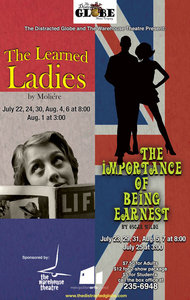 Jennifer Goff of The Distracted Globe has set herself the arduous task of adapting Moliere's 1672 Les Femmes Savantes to New York, 1930. And she kept the convention of rhyming couplets.
In keeping with true review form, the next sentence should propose some sort of value judgment of the production. This is tricky. In complete honesty, I'll admit that I did not particularly enjoy the show. But then, in complete fairness, I'll tell you that I was the only person in the audience who didn't.
I have never (never!) heard an audience become so invested in a play. I am accustomed to The Excessively Loud Individual who annoys the rest of the patrons with his demonstrative responses. The Learned Ladies was my first experience with an entire audience hooting, howling, groaning, yelling at the characters (and at each other), clapping in the middle of scenes, and laughing with abandon.
Moliere's play lampoons hen-pecked husbands, domineering women, googily-eyed romantics, and those obnoxious fake intellectuals who say nothing of value (and write very very bad poetry). It's a fun story with our favorite caricatures, and the production serves up some beautiful acting. Stephen Boatright (straight-man Artie) and Kerrie Seymour (wife-from-Hades Phyllis) are entirely convincing; Cindy Mixon (the lusty Bessie) and Joel Perkin (the weak-kneed husband Chester) are literally a hoot. The staging is by turns corny and brilliant--the firing of the maid and the swooning over lousy poems are both crackling scenes that I would gladly re-watch.
So why didn't I enjoy the show? I didn't feel the production gave me liberty to do so. The play (remember) is composed entirely in rhyming couplets. Bad rhyming couplets. Really, intentionally bad rhyming couplets. The first ten minutes found the actors struggling against the language--trying to mask the galloping rhythm and obvious jangles. This straining set-up did not give me permission to groan at (what I perceived to be) the adaptation's gloriously self-conscious corniness. I was programmed to think--"Oh, what horrid greeting-card language. Let's cover that up."
Within this framework, the script worked best when its actors were able to completely overcome the clunky rhythm (in which task Seymour and Boatright excel) or occasionally when they could clue me in that they were going to ham-it-up on the obvious rhymes (Mixon and Perkin's domain). Given these two modes, the play seemed conflicted about itself--were these bad rhymes meant to be taken seriously? Or no? Or (given the audience's obvious delight) was I just one of those wretched Learned Ladies (shudder) who think too hard about everything? I don't know.
I do know that my fellow audience members had a lot more fun than I did, and I found myself wishing I could enter into their infectious glee. So. Here is my proposition of judgment: This disparity in our reactions says something very good about the production. If the entire audience has a middling-good experience, something is amiss; Theatre is supposed to be about heightened experience (be it positive or negative), and in this The Learned Ladies overwhelmingly succeeds. And given the ratio of ayes and nays (only 1 opposed and a nearly full house in stitches), it's a pretty safe bet that you'll do more than enjoy the show. You'll love it. And when you do, please hoot a little on my behalf.
--
Moliere's "The Learned Ladies," Adapted and Directed by Jennifer Goff
Presented by The Distracted Globe at Warehouse Theatre, 37 Augusta St., Greenville (864) 235-6948. Through August 7. Tickets $7.50.
I am a certifiably Bad Theatre Person. Before last night, I had refused to have anything to do with Oscar Wilde's The Importance of Being Earnest--refused to read the script, endure the ubiquitous stagings, watch the film. Perhaps this is excusable? High school and undergraduate years proved to be one nearly-unending stream of badly acted Earnest scenes. I am happy to say--quick toss of the hair--that The Distracted Globe has cured me of such snobbery.
Director Jerrold Scott sets the play in the 1960s: high-fashion London. Expect delicious costumery and makeup, exquisite posturing, and music that kept several audience members singing along at intermission. Also expect some whiz-bang character actors.
Ryan Bradburn's Algernon and Roberta Barnes' Gwendolen are so flamboyant in their over-hyped (and over-sexed) 60s personae that it's hard to take your eyes off 'em. Their glorious poses and expressions are a treat. I could have wished for just a smidge more grounding in Algernon--he's already wickedly funny, but a tinge of emotional truth would have made him irresistible. Jared Johnson (playing the servants Lane and Merriman) also deserves quick props for drawing out the most laughs without even talking.
But most of all, there is The Lady Bracknell. And since I am speaking of the queen of snobbery, I will confess to a bit more snobbery of my own. I adore Anne Kelly Tromsness, believe her to be one of the most versatile actresses I've seen in my three years of Greenville theatre-ing. Even so, I had a moment of doubt--Tromsness as Bracknell? Eh. We'll see. (See? Snobbery. Snobbery-snobbery-snobbery.)
Well, phooey on snobbery--Tromsness has me in spades on this one. She is exact (and exacting) as the snotty London socialite, flowing through motions and inflections so precise that she is terrifying. You could bump into this Lady Bracknell on the street. (If she ever deigned to frequent your side of the street, that is.) Tromsness' baffling precision may well be one of the highlights of my theatre season--and at only $7.50 a ticket.
$7.50. Kudos to Distracted Globe for providing affordable theatre that does not affront the sensibilities of the snobs among us (namely, me). Snob though I may be, after last night, I will happily seek out another Earnest. I just hope it's as pretty as this one.
--
Oscar Wilde's "The Importance of Being Earnest," Directed by Jerrold Scott
Presented by The Distracted Globe at Warehouse Theatre, 37 Augusta St., Greenville (864) 235-6948. Through August 7. Tickets $7.50.
 Peter Shaffer's "Amadeus" is one of those Important Plays, works of art full of giddy genius, reckless jealousy, and the hard hard questions of life. Warehouse Theatre delivers a scintillating production, brimming with all of those things: storms and light, gaiety and ruin, and laughter! But there's also something else in there, something harder to stomach. A truly unsettling stroke of mediocrity.
Of course, it's much more fun to start with the genius. Mozart. Matt Creacy's composer is shockingly effervescent--he's exudes so much joie de vivre and juvenile delight that I found myself surprised to actually believe him. But, oh, did I ever believe and love him. Creacy is infectious and inspiring (even to someone inclined to discount the more, ahem, scatological shades of his humor). His love Constanze is equally buoyant--Tara Sweeney charms much more with her giddy, silly jokes than she does with her later (overwrought?) grief.
So this Mozart of the potty mouth enters the royal court in Vienna. It is a most gossipy, backstabbing city, as exquisitely portrayed by the Venticelli. Jared Johnson and Matt Reece deliver a hilariously stylized duo that commands any scene it enters. It's a good thing it never actually enters the court with Joseph II. Chris White's Emperor of Austria is not a man to be upstaged. White gives a delightful performance as the "benevolent" (and ultimately ignorant) head of state. The rest of the court is appropriately stodgy, especially Kelly Ward's deliciously mute wife-of-Salieri.
And Salieri. Salieri. Here is where we get hard to stomach. Salieri, as written by Shaffer, is larger than life. He's the villain to beat all villains--Vienna's musical man of the hour plots to ruin Mozart. He's big and full of raging thunder against God. Just not as played by Paul Savas. Savas opens the show with an alarmingly normal, chummy man. To be frank, I was affronted. I came to see a sneaky old man. I came to see thunder. I demand to see thunder. Which of course, should tell you that Savas (and director David Sims) understand something far more important about the script.
By resolutely denying Salieri's inherent melodrama, Savas creates a villain that is disconcertingly familiar. I found myself begging for more fireworks--not because fireworks are fun, but because this Salieri was too very like me, and I wanted an out. Give me a pompous, overwrought mediocrity. Let me say "tsk tsk tsk!" and leave it at that. Don't--don't--sit in my seat. Which is, of course, exactly what the self-proclaimed patron saint of mediocrity should do. Be normal.
Do not misunderstand. Savas does hit Salieri's breaking points beautifully. He just refuses to cave in to that alluring tug of melodrama, and I commend him for that, even though it stings. Especially because it stings.
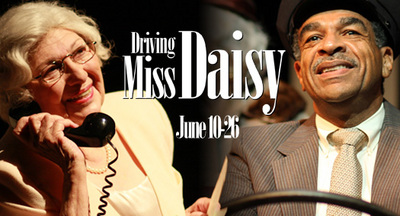
"They are like having little children in the house. They want something so they just take it. Not a smidgen of manners. No conscience." This is Miss Daisy's summation of all "coloreds," including the chauffeur her son has just foisted upon her. But you know she's not prejudiced. What a hateful thing to say, that she might be prejudiced! It's Alfred Uhry's "Driving Miss Daisy" at Centre Stage--the the hilarious and touching ride through Daisy's thirty-year relationship with her chauffeur.
The cast is uniformly funny. Rick Connor's perennially agitated Boolie, Clark Nesbitt's affable Hoke, and Shirley Sarlin's conflicted rich lady Daisy. They'll keep you in stitches as they pair up and square off over trifles (going 20mph under the speed limit? ambrosia? a can of salmon?) and not-so-trifles (the proper care of graves. Learning how to read. Lynchings.) As Daisy and Hoke bicker and poke their way to an unconfessed affection for each other, they don't miss a single exasperated joke, and neither does the audience.
My only quibble is this: perhaps we laugh too much. The most profound and important scene thematically (the "invitation" to the Martin Luther King, Jr. banquet) is played as coyly as a sketch on high school break-ups. Sure we laugh, but we lose the punch: The cowardice that Daisy still faces after all these years of friendship and bombings and lynchings. Hoke's bravery in standing up to her. The fact that things haven't changed all that much. Not then. Not now. We're still having these same awkward, side-stepping conversations. But the potential disturbances are glanced over, lost, and the story quickly slips back into its house robe. It's a robe we love, light and airy and comforting. But had the production seized on this little bit of darkness, "light" could have meant more than an absence of weight. It could have been a beacon.
Profundities aside, Chip Egan still directs a doodle of a bittersweet show, a family-friendly knock-out that will beguile the night and send you out refreshed. Don't miss it.
--
Alfred Uhry's "Driving Miss Daisy" Directed by Chip Egan. Lights: Ron Pyle. Scene: David Hartmann. Sound: Wade Powell.
With Shirley Sarlin (Daisy), Clark Nesbitt (Hoke), and Rick Connor (Boolie).
Presented by Centre Stage, 501 River Street, Greenville, SC (864) 233-6733. Through June 26. Tickets $25, with discounts for seniors and students.
(Not a revu of Pintr's Dumb Waitr @ Brd & Baby Theatr)
1. U cn keep ur cellfon on 2 text n tweet.
2. Snappy produxon
3. By nu theatr n town!
4. U must admit, garage is perfct settng 4 Dumb Waitr.
5. Sum of best actng seen n upstate Chris White=most luvabl Gus Evr!
6. 2 mebe 3 shos left
7. Only $10!
8. 2 resurv tix: 864-640-2901
--
Harold Pinter's "The Dumb Waiter"
Presented by The Bird & Baby Theatre.
Through June 5
Tickets $10. Call 864.640.2901
 Vincent is running away from love. Or running to love; he's not exactly sure which. Instead of meeting his girlfriend for some quick Mexican in Chicago, he's hopping the last flight to Paris and hoping to learn the ways of romance from the grandfather he never met. This is the opening of Mat Smart's The 13th of Paris. This is also the best (best!) feel-good play of the season. It's a richly textured comedy treating all the strands of love: French realistic, French magical, American, American-blase, American-alien, and of course, the unabashedly Skanky.
Warehouse Theatre and director Adam Knight have assembled a delightful cast for this regional premiere--the return of Thomas Hudgins (Vincent) and Elizabeth Finley (Annie) is cause for rejoicing. Their chemistry crackles across trans-Atlantic phone connections and in unexpected spring showers. Debra Capps (Jessica) and Daryl Phillipy (William) have the audience howling as the over-sexed newlyweds who accost (literally, hormonally, hilariously) the beleaguered Vincent.
But camp and fury aside, the creme de la creme of this show has to be the grandparents: Jacques (Jim France) and Chloe (Kerrie Seymour), who meet in the storied Parisian cafe and have a romance worth dying for. France and Seymour assume their roles with such grace and openness that they leave the rest of the talented cast far behind. By the sheer force of lovely acting, the grandparents' fairy-tale romance becomes tangible reality, and the turbulent present is exposed, for a season, as a farcical cartoon caricature.
But only for a season. This play speaks as much for realists as for sentimentalists. Every romance, no matter how boring or bawdy, has its own flavor--something worth savoring and celebrating. And pursuing. It's a lesson Vincent learns only reluctantly, as he lets go of the shimmery past to pursue a quirky, fulfilling present with the girl who just happens to be fluent in alien.
The grandparents, it seems, do know best. They lured Vincent to Paris. They'd lure me back to the Warehouse for a repeat performance. Not bad for a couple that's been dead forty years. Let them lure you...and whatever sort of romantic interest you're pursuing these days.
--
Mat Smart's "The 13th of Paris," Directed by Adam Knight
Presented by The Warehouse Theatre, 37 Augusta St., Greenville (864) 235-6948. Through May 22. Tickets $25. Students $15.

The DAP theatre is partnering with Safe Harbor women's shelter and local playwright Anne Pecaro (me!) to produce an evening of theatre that explores violence toward women and the devastation left in its wake. The play opens August 5. Rehearsals will begin mid-June.
We need 2-3 women of all ages.
Auditions April 23 (7pm) and April 24 (5pm)
See the Facebook Event for more details or to RSVP.
If you aren't on Facebook, e-mail thedevilsadvocateplayers@gmail.com or call 925-759-9119
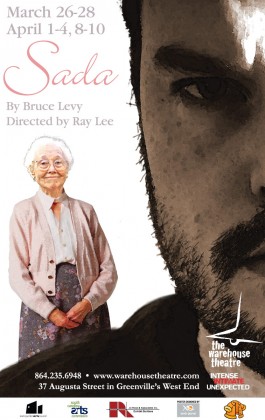
The first admonition: Come Early. You'll want to spend some quality time with the exquisite set Shannon Roberts has designed for Warehouse Theatre's latest production. It's a Bronx apartment in all its (cramped) glory--an elderly woman's abode, brimming with all the sentimental bits you loved at grandma's house. It's the first set that's tempted me to leave my seat and poke around its nooks and crannies. So take some time, and let your eyes do the exploring. Once Sada begins, you aren't going to be paying attention to it at all.
The second (and final) admonition: Stay Awhile. Bruce Levy's Sada is like your grandmother; it rambles a good bit. It makes a few illogical leaps of the mind (most notably one minor character's instant transformation from bull-headed to push-over, or whispy bits of farce sticking out at odd angles). But, Stay Awhile. Or, as Sada would say: Sit! Eat! Drink! This is a visit worth sticking out.
Shirley Sarlin headlines as Sada herself: an elderly Jewish lady who takes a shine to the young Hispanic man who's come to rob her. Sarlin delivers a sometimes feisty and always lovable performance as the granny who is nobody's victim--not the robber's, not the cops', and certainly not her son's--an old lady who just might turn out to be everybody's saint.
Chris Hecke (Angel), Jared Johnson (Officer Blum), and Peyton Hray (Officer Morelli) form an admirable lot of hooligans in need of saving, but Rick Connor's Ira is by far the comic steal of the show. It's no secret that Ira has heart troubles. Sada tells you this at the very beginning. But when Connor appears, the already funny play takes a turn for the hilarious--and the truly moving. Like any good grandmother, Sada has heat-changing lessons for everyone. But most especially you. And most especially herself.
Come early. Stay awhile. Sada wouldn't let you leave anyway. But what does that matter, when you've already fallen in love with her?
--
Bruce Levy's "Sada,” directed by Paul Savas.
Presented by The Warehouse Theatre, 37 Augusta St., Greenville (864) 235-6948. Through April 10. Tickets $25. Students $15.
 I need to open this review with a brief confession: I'd like to live closer to New York. Love to live closer to New York, actually. I tell myself that just about anybody with a passion for the stage wants to be in New York, that most of us outside of New York are justifiably melodramatic (perhaps you've heard us?) in complaining about the mythical misunderstanding, oppression, and death of theatre everywhere outside of New York. Ha. After what happened at the Warehouse Theatre last night, I need to do penance for such unholy thoughts. Jayce T. Tromsness directed such a Macbeth as would make any theatre nut proud to stand up and be counted a Greenvillian.
There are no kilts (or robes). No grown men holding twigs in front of their faces. Not much of anything that you've come to associate with Macbeth, except the language. Tromsness sets the Scottish play in the Balkans, in the war-torn Bosnia of the 90s. Shannon Roberts comes through with an emotionally charged set--you'll be tempted to weep before the action even begins, but wait. The first ten minutes of the play are some of the most muscular and harrowing moments I've ever seen on the boards. They were in fact the most harrowing moments I'd ever seen--until we came to Macduff's pretty chickens and their dam. Yes, I cried.
With a production as stunning as this, it's hard to find highlights, so I offer instead a list of the things that are still lingering with me the morning after:
The weird sisters--Lynne Junker, Tiffany Nave, Kerrie Seymore. They don't have beards. Or matted hair. Or long bony fingers. But give them turbans and swaths of dirty lace and talismans and they'll haunt you tomorrow and tomorrow and tomorrow.
Blood. Entrails. Blood-shot eyes. Blood. I won't tell you how they do it, but the result is chilling.
Hecate. Anne Kelly Tromsness is the ultimate argument for the existence of Hecate. And her doubling as the ever-present Doctor gave a chill-bumping reminder of the strange forces at work in this world.
Ghosts! Banquo (astonishing show from Andy Croston) and his unending line of wraith-like kings.
Humans. Real humans. The Lords and Ladies Macbeth I have known in the past have already seemed to be kings before the play begins. Regal, imposing, infinitely above me and my little concerns with the world. What Paul Savas and Debra Capps bring to these roles is an unsettling familiarity. I was shocked by the every-day-ness of their language, their actions. They are more relevant than regal, which gives them an especial terror: that could be me. That could be any one of us. Don't get me wrong. When the time comes for the big explosive speeches, Savas and Capps are dynamite. But the part of their performance that is still with me today? Act Three, Scene Two--a brilliant and beautiful fight between the husband and wife.
Macduff, Macduff, Macduff! Such a stirring performance by Brock Koonce--anyone can muster a few tears for dead kids, but his show after Duncan's murder? Took my breath away--and that in a scene that has always made me cringe for false notes. I would I could usurp Shakespeare and make Macduff the next king.
How to tie up all these disparate memories? With the man who made them possible to begin with, and I don't mean Shakespeare. I've seen enough wimpy concept-driven renditions (Macbeth as a mostly-danced fable set in western Africa?) to know that the Bard alone doesn't bring this kind of muscle to a production. The director, Jayce Tromsness, has created some of the most human and horrifying Shakespeare I've experienced to date: his Macbeth is a figure from the nightly news, from Iraq or Afghanistan or any other war we've sat and watched from our armchairs. More than this: its the only Macbeth that has wrested my focus away from Otherness and War and turned a level gaze to my own sneaking ambitions. And isn't that supposed to be the point? Encore, Mr. Tromsness. Encore.
 Appalachia 1912. Expect music from the hills, family, old-timey ways. But don't expect the good ole days. The miners are being forced into more and more degrading, life-threatening conditions, and those who disagree are run off the company property. Enter a strike. Enter armed guards, and a family torn--members living and dead, straddling both sides of the not-so-proverbial fence. This is Walter Thinnes' "Coal Creek," Winner of the 2009 New Play Festival, and produced by Centre Stage.
Caleb (Jeff Warren) and his son Joshua (Justin Walker) face off as father and son on opposite sides of the labor war. Aunt Lillian (Alyx Clements) and Anna (Olivia Wilusz) try to outfox the camp guard Quinn (Bruce Meahl) to get food to Joshua and the other starving strikers. It's a uniformly strong cast, with a sparkling performance by Alyx Clements--her feisty Lillian is the highlight of the evening, so honest and homey you'd think she just happened to wander in here from camp. And when she matches wits and wills with Quinn? Expect fireworks and lots of laughter, and a delicious of feeling of relief that you aren't on the receiving end of all her "attentions."
You'll also be glad you didn't live in the sepia-toned past, at least not when real history rears its grisly head. Thinnes has taken up the story of the West Virginia Mine War, and he doesn't shy away from the facts. But he also finds an impossible path--the one narrow road leading to a feeling of hope and triumph.
This is a new play. Approach it not like a baby, but like a teenager. It's growing. Sometimes it doesn't know what to do with its lanky appendages. It's often long-winded, and sometimes traffics in cliche, but thanks to Brian Haimbach's insightful direction--the play just might surprise you with its passion and humor, its clarity on disturbing passages in history. And you'll be one of the few, the hearty few, who can point to the successful grown-up play and say, "Yes, I knew Coal Creek, way back in the good ole days."
--
Walter Thinnes' "Coal Creek," Director: Brian Haimbach. Scene: Wendy Marriott. Sound: Richard Beveridge. Lighting: Marlaina Seay. Costume: Deb Warren. With Jeff Warren, Bruce Meahl, Alyx Clements, Justin Walker, Olivia Wilusz.
Presented by Centre Stage, 501 River Street, Greenville, SC (864) 233-6733. Through Jan 30. Tickets $10 ($5 students)
 I was a junior philatelist for ten years; I breathed stamps. And even I was skeptical about "Mauritius'" premise. Nostalgia maybe. Charm definitely. But adrenaline? Fear? Over little pieces of paper? Probably not. I was mistaken. Centre Stage's production of Theresa Rebeck's "Mauritius" (rhymes with malicious) is a perfect suspense for this spooky season.
Jackie (Debra Capps) slogs through the aftermath of her mother's death: the house, the stuff, demons (and bruises) of a past life, mountains of bills she can't even read. There's one glint of hope: some old stamps bequeathed to her on mom's deathbed. A pair of Mauritius stamps, each worth enough money to solve everything. Unfortunately, the stamps also come with an estranged half-sister, a has-been philatelist, and two violent con men (Brock Koonce and Neil Shurley). Cue action.
From David Hartmann's tight set to J. Michael Craig's musty old Phil, the show genuinely surprises. But if the stamps are the “crown jewels of philately,” the crown jewels of this production are the sisters, Jackie and Mary. Debra Capp's Jackie is funny, painful, and poignant. She's been through the apocalypse of a family, and while she's deeply damaged, she's still fighting. I wouldn't mind seeing a sequel—what happens to Jackie after—provided Ms. Capp is in the role.
And Mary. Mary, Mary, Mary. She's also a survivor, though of a different strain. Anne Kelly Tromsness's Mary is so real, it's almost hard to hate her. Almost. But hate her or no, Tromsness gives her so much depth that you can't help hoping she'll come to her senses.
You'll pull for Jackie's right to those stamps all the way through the harrowing show, but Theresa Rebeck's script delivers something you didn't even think to want: the realization that no amount of money can fix the past. Or even the present. But with a little luck and some very quick thinking, you just might be able to imagine a better future.
--
Theresa Rebeck's "Mauritius" Directed by Chip Egan. With Debra Capps, J. Michael Craig, Brock Koonce, Neil Shurley, Anne Kelly Tromsness.
Presented by Centre Stage, 501 River Street, Greenville, SC (864) 233-6733. Through Oct 31. Tickets $25, with discounts for seniors and students.
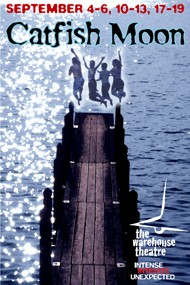 There's a big old moon tonight—yellow and dripping down color on the moss. There are some shooting stars and a few stray bolts of lightning. Old timers would tell you it's the perfect night for catfish. The horoscope hotline would tell you it's the perfect night for romance. And then there's Frog, who would tell you it's the perfect night to beat your (former) best buddy to a pulp. Director Francis Kuhn gives you a little of all three in Warehouse Theatre's production of “Catfish Moon.”
It was Curley's idea, so you can blame him. He organized this reunion of sorts, calling up old buddies and trying to patch things up. He's always been the big brother, the umpire, taking care of everybody, even getting them all baptized at the tender age of ten. He's an all-around good guy, and actor Will Ragland succeeds in catching his startling mix of fun and gruff tenderness. Unfortunately for him, Curley may have bitten off more than he can chew this time: Frog and Gordon are fighting for keeps.
It's about a woman (what else?) It's about Betty, the only female in the cast, and a welcome relief from all that testosterone. Erin Smith makes a refreshing small-town girl—a woman who speaks her mind without tromping over the people around her. Very much unlike Frog. Jason Johnson serves up such a believable spit-fire performance as this red-neck extraordinaire that I swear I went to school with this guy. And while I'm glad I never dated (or married!) Frog, I was more than thrilled to spend a couple hours in his company. You will be too—Johnson is an absolute delight on the stage, especially when he's coming after Gordon, the lovable, emotional, somewhat off-balance suitor played by Elvin Clark. He's as tender as Frog is feisty, and it takes a serious blow to bring them all together again.
And therein lies my minor quibble with the production. Sartin's plot is a bit predictable, the conflict and its resolution coming too easily in spots. But this contempt bred of familiarity is quickly won over by Sartin's genius for southern dialog—always fresh and funny, never cliché. It's a script whose cadence surprises, if not its plot. And there's one last treat in store, too: Shannon Roberts has created a surprisingly emotive set for this reunion of middle aged friends. Her decrepit pier shows its age every bit as well as these old pals with their failing health, love lives, addictions, and deeply personal feuds. But like any trusty friend, or pier, everything's still standing at the end, ready for more fishing, more fighting, and maybe, just maybe, a little bit more loving.
--
Laddy Sartin's “Catfish Moon,” directed by Francis X. Kuhn.
Presented by The Warehouse Theatre, 37 Augusta St., Greenville (864) 235-6948. Through September 19. Tickets $25. Students $15.
 It's time to watch the new plays hatching in South Carolina. Hope to see you there all next week (9/14-9/18) for FREE play readings, 7pm each night, at Centre Stage.
And, as if you haven't had enough, I'm hosting a play reading for a few works-in-progress over at The Bird & Baby Philosophy Club on September 19, 7pm. Bad timing, I know--so much new play-ing in one week! I could blame it on my professors and deadlines, but really, I enjoy the work too much for that.
Event Blurbage follows. You have been warned.
The Thinks We Have Thunk
Three New Works in need of Actors / Readers/ Listeners for one night of cold readings
Saturday, September 19, 2009
7:00pm - 10:30pm
The Bird & Baby Philosophy Club
1008 W. Poinsett St, Greer, SC 29650
Join us at The Bird & Baby Philosophy Club for some new play development! Member Stephanie Young has three new works that she needs to hear before sending them off for MFA-ing. We'll provide coffee and munchies, chairs and scripts. You provide the voices, the audience, the constructive critique. A good time to be had by all.
More details on the scripts:
A one-act comedy. A ten-minute drama. And the first act of something dark & surreal. If we had to rate 'em, the content in these scripts ranges from PG to R (for language, thematic content, innuendo). Anyone is welcome to come and read and/or listen, so invite your friends, but do the kind thing and let them know what they're in for!
We have reading parts for as many as 4 men, 6 women, and 3 either/or.
We can get by with as few as 3 men, 3 women, 1 either/or.
Hope to see you there!
Oh, oh, I'm packing my bags for oh, oh, Oh-Hi-Oh.
This little playwright is headed to The International Centre for Women Playwrights retreat--it kicks off on Sunday at Ohio State and The Jerome Lawrence and Robert E. Lee Theatre Research Institute. I hope to post some stuff from our sessions and late night readings of works in progress, maybe even catch a show in downtown Columbus.
Unfortunately, this means no Greenville reviews from now until September 8, when I return from a post-retreat jaunt to Colorado.
Hopefully, I'll only be missing one show:Country Queens at Centre Stage, so check it out and tell me how it goes!
I'm trying to hit Catfish Moon over at The Warehouse when I get back, but I'm also in performances that weekend for Two Gentlemen of Verona at ye olde alma mater. Maybe Sunday.... Here's hoping you can see it before I do!
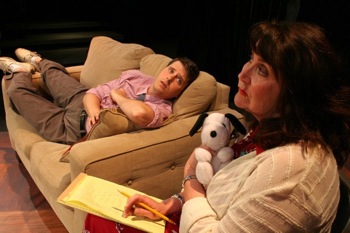 The Distracted Globe's mission is to produce classic comedies. Classic. And it is with great sorrow that I announce to you that the 80s are now considered classic. The 80s! When the hope of a jacuzzi inspired every man, and the promise of a salad bar could salvage the worst of blind dates. Also, the 80s of raging jewel tones and America's sexual identity crisis, a-bi-homo-what-on-earth-am-I-sturm-und-drang. In all this mess, it's important to have a therapist, don't you think? It's what the characters in Christopher Durang's “Beyond Therapy” would tell you. Especially the therapists.
Dr. Charlotte Wallace's programme for mental health in this milieu: sleep with whomever, whenever. Hurl vulgar epithets whenever the desire o'erwhelms you. Blind all the horses with a metal spike. It never hurts to hug Snoopy. For this sage advice you will pay more than a few pretty pennies. Just don't expect the therapist to listen real well (or at all)—or even remember your name. The poor saps who fall into Dr. Wallace's (and Dr. Framingham's) clutches...did I say clutches? I meant crotches. No! I meant, couches. Couches. The poor saps who fall into the therapists' couches act out this absurd regimen to hilarious results. Especially the therapists.
All the actors—Jared Johnson's creepy Bruce who is trying to woo Jennifer Goff's unsteady Prudence while also living with his lover (Justin Walker's stiff Bob, who wishes to lay Moses L. Rickett's none-too-empathetic Waiter)—they're all a riot—ungainly, wobbly on their feet and in their emotional lives. Especially the therapists: Rick Connor's strung-out, macho Dr. Framingham, and Kelly Wallace's psycho Dr. Wallace. While it's obvious these therapists are little more than sexual predators and voyeurs par excellence—they're the humorous highlight of the show.
Kelly is a relative newcomer to the Greenville stages, and this is her juiciest and most triumphant performance to date. If you can survive the sexual meet ups and break ups and swap outs--and Durang's often self-indulgent script (2 hours? Really?)—it's worth it to see this performance. Wallace sings! (And I'm not talking about the sort of singing done by Bob's possibly transvestite mother.) Kelly's perfectly tuned to this bizarre role, and I'd give all my pennies to sit on her couch and watch her work her crack-pot magic again.
---
Christopher Durang's “Beyond Therapy,” directed by Michele Labar. Presented by The Distracted Globe Theatre Company at Warehouse Theatre, 37 Augusta St., Greenville (864) 235-6948. Through July 31. Tickets $7.50.
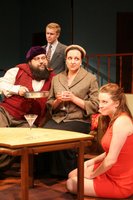 Corie Bratter is newly married and in love with everything—the backwards plumbing in her fifth-floor apartment (be sure to flush up), the hole in the skylight, the exorbitant rent, the lack of cups (old tin can, anyone?), and especially, especially her new phone (princess style, in beige, lights up). She's in love with it all for ten whole minutes, about the time it takes for hubby climb home with a promotion and a briefcase full of work and the honeymoon is so over, baby. The audience, however, is just about to fall madly in love with Distracted Globe's summer offering: Neil Simon's “Barefoot in the Park.” It's a buoyant party of a play—and a smashing way to spend a hot Greenville night.
Elizabeth Finley is a gas to watch as the flighty housewife, and her husband Paul is delivered up by Thomas Hudgins, a man fluent with the fumblings of the newly married man. Then there's the upstairs neighbor, the aged gourmet and womanizer from Eastern Europe—a hilarious role for Jayce T. Tromsness. Of course he's in love with the pretty young thing downstairs. Of course he's way more fun than the stuffed shirt of a lawyer husband, especially after said neighbor has downed a few ouzos. And of course, of course, Corie's mother is quite offended. Hurt, really. She needs to go home and give herself a Toni Home Permanent. (But actor Anne Tromsness is such a dear, you hope she'll keep dragging herself up those five--or is it six?--flights of stairs, for unannounced visits.)
Director Jennifer Goff has created an energetic and touching production, despite Simon's shopworn advice to the newly married woman (item #2: just stroke the male ego a bit, and you'll be fine). It's advice that (thankfully) gets lost in this kerfuffle of comedy, and the characters just might succeed in finding their own marital balance—but not before a few more gaffs pack the audience off laughing.
Be sure to drop in on Bratters while you can. Tell them I sent you. I promise, you won't have to climb six flights of stairs to get there, but if you did, it would definitely be worth it.
---
Neil Simon's “Barefoot in the Park,” directed by Jennifer Goff. Presented by The Distracted Globe Theatre Company at Warehouse Theatre, 37 Augusta St., Greenville (864) 235-6948. Through August 1. Tickets $7.50.
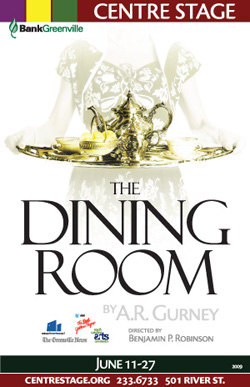 To half the play's population, the cavernous dining room is a place to flee, demolish, or desecrate. To the other half, it's home sweet home: leisurely breakfasts, the view of the gardens, exquisite meals. Whether you loved or loathed the formal room, one thing is certain: it's been extinct for quite some time, but you can see it again—in all its glory and monstrosity—in Centre Stage's production of A.R. Gurney's “The Dining Room.”
In nearly two-dozen scenes (all of them unrelated), six actors play over sixty different characters whose lives are changed (often humorously, and often for the worse) in the dining room. It's a breathless tour-de-force and a stunning study of a culture that is no more. It's unnecessary to note that actors chosen for such demanding work are flexible—they are, and terribly funny also. But three actors deserve special recognition. Each of Anne Elizabeth Butler's characters had such rich emotional depth that I wished the scenes were longer, just so I could see more of these people she created. Allen Evans and Christopher M. Evans also boasted especially crisp, delightful performances.
Despite the zest and humor, the accumulation of so much destruction provides a rather loud indictment of the once-powerful W.A.S.P. culture. Fortunately, the verdict on the dining room itself is still out. This ambiguity is thanks in part to Benjamin P. Robinson's level-headed direction—his characters are people, not caricatures bearing some heavy message. They may be wealthy (or wish they were) but they are still human, and the communal nature of a dining room can still work some positive magic upon them. Part of that magic is in Guy Perticone's subtle lighting. You wouldn't think there's much you could do with a chandelier and some implied french doors—but Perticone works this limited vocabulary with such finesse you scarcely noticed the room's stunning mood swings.
The dining room it turns out, is the most noble character in Gurney's play—holding and hiding and softening the edges of a high-stress, high-stakes population. When the room fades into memory, into dream and reminiscence, you'll wish you could resurrect it, if not necessarily all of its inhabitants.
--
A.R. Gurney's “The Dining Room” Directed by Benjamin P. Robinson. With Anne Elizabeth Butler, Katy Beth Cassell, Allen Evans, Christopher M. Evans, Cindy Mixon, and Jeff Warren.
Presented by Centre Stage, 501 River Street, Greenville, SC (864) 233-6733. Through June 27. Tickets $25, with discounts for seniors and students.

There are as many Hamlets as there are directors, and with good reason—with over four hours of text to cull and scores of interpretative theories (focusing on anything from the absurdity of life to extra textual sexual psychoses) Hamlet may as well be the springboard for a choose-your-own-adventure event. Unfortunately, that's how many productions of Hamlet come off—willy nilly. Fortunately for Greenvillians, Paul Savas of the Warehouse Theatre has trimmed Hamlet with a sensitive ear, shuffling scenes and lines to give the audience a clear window into the story. The result is a lean, powerful performance that highlights the terrifying and beautiful providence of Hamlet's fall.
Providence haunts the play almost as much as Hamlet's murdered father, with lines from Act V working their way into a number of scenes: “There's a special providence in the fall of a sparrow.” This sparrow's falling seems to be the central metaphor for Jason Shipman's elegant performance. Unlike so many numb melancholics, Shipman's Hamlet is refreshingly emotive, fragile and fluttering against the inhuman political machine. Shipman drowns in grief and rage, teeters on the borders of madness. His Hamlet is moved by mad fortune, and what's more, he moves the audience with that same madness.
Would that all the cast could do the same. While there are several strong performances (Kerrie Seymour's beleaguered Gertrude stirred the heart, and Joe Wrobel's Polonius rang true every line), a few notable exceptions caused discomfort. While it's normal to have a range of talents in such a large cast, it is nearly unforgivable that it should happen in the leading roles, especially leading female roles, as there are precious few of them in Shakespeare and a line of talented actresses to fill them. Talented though she be, Tiffany Nave doesn't appear quite comfortable in Ophelia's skin. She's got all the mannerisms of a giddy young innocent, and some loose bits of the hysteric, but that's all I could detect—mannerisms, bits, externals lacking heart. Of course, one may make the argument that even Ophelia wasn't all that cozy with herself—she did go mad after all—so I'm willing to concede that a more learned observer will catch something I have missed.
Surprisingly, this Hamlet's Ophelia isn't all that important to the production. Hamlet's got another, deeper relationship with Horatio, and this friendship is, after Shipman's performance, the chief delight of Warehouse's production. Hamlet and Horatio's shared friendship is a quick mixture of tenderness and strength, a delight to watch. Were it not for Andy Croston's steadfast Horatio, one suspects this Hamlet would have been crushed all the sooner.
The purists can argue about the stabilizing necessity of Fortinbras, sweeping in and setting all to rights. He isn't in this production, and he isn't needed. The Warehouse has given us a far better catharsis than that clunky machina. Here in the inevitable approach of the final scene, there is such truth, such comfort in Hamlet and Horatio's confidences that Shakespeare's “special providence” takes on an electrifying new meaning. Where once stood blind and furious fate, there now stands a tender grace that cushions the sparrow's fall in the arms of his best friend. It's a fall at once terrifying and beautiful—we all must end some day. “If it be not now, yet it will come: the readiness is all.” The readiness, yes, and the company in which you pass those final moments.
--
Shakespeare's “Hamlet,” directed by Paul Savas.
Presented by Warehouse Theatre, 37 Augusta St., Greenville (864) 235-6948. Through June 13. Tickets $25. Students $15.

Before I say anything about Warehouse Theatre's latest production, I think you need to know, I've been bribed. Really. How can you not say something nice about the man who gives you a rose and says you're beautiful? Of course, Aldo's Italian, and true to stereotype, he probably tells this to a lot of women. At least one a night during the run of John Patrick Shanley's "Italian-American Reconciliation." So chances are pretty good that Aldo just might bribe you. Or your date. And believe you me, you will say nice things about him and this whole story he's telling--it's beautiful.
It's about his best friend, Huey, a big nervous wreck who's been falling apart ever since his divorce from Janice. It's about how Huey needs to reconcile this thing with Janice, needs to confront it and get past it before he can be man enough to love Teresa (a strong showing by Elizabeth Finley). It's a good story. Rick Connor makes such a quirky and moving Huey that you'll laugh and cry and hope right along with him.
Trouble is, Janice, she's not so nice. Stars make her "think of death." She shoots dogs. And men. And Anne Tromsness imbues her with such raging emotional complexity that you never know if she's going to kiss you, or knife you. Huey, he's a bit gun shy. So he does what any red-blooded Italian would do: he sends his best friend Aldo to smooth things over.
It's Little Italy. There's no telling what might happen, or who will run off with (or without) whom. But in all the upheavals, one woman stays the same: Aunt May (charming performance by Annette Garver), who dishes out minestrone and advice by the bowlful. She may not be sure "whether all the stuff I remember is wisdom, or just lint," but my money's on wisdom. Her insights on life and love and trouble are worth more than any seminar.
And since I've talked about everybody else, I suppose it's only fair, in closing, to say a word about Aldo, the sweet-talking Italian with a thing for (and against) women. Bribery aside, Andy Croston delivers his best performance to date. He's come home with this fast talking, emotional Italian, and you will too. His Aldo is an able guide through the turbulent romances of Little Italy, where everyone changes, everyone grows, and everyone comes to an honest place, including the audience.
--
John Patrick Shanley's "Italian-American Reconciliation," directed by Jayce T. Tromsness. With Andy Croston (Aldo), Rick Connor (Huey), Elizabeth Finley (Teresa), Annette Garver (May), Anne K. Tromsness (Janice).
Scene Design, Shannon Roberts; Lighting Design, Ursula Finley; Costume Design, Jayce T. Tromsness; Sound Design, Kevin Frasier.
Presented by The Warehouse Theatre, 37 Augusta St., Greenville (864) 235-6948. Through May 2. Tickets $25. Students $15.
 The intended recipient of a heart transplant dies in surgery. You've got 45 minutes to get a new patient ready. Choose one of the following: the lovable, but overweight black man, the elderly lady who has spent a lifetime helping others, the angry poet who's having a spiritual awakening, or the billionaire's son (who just might give you enough money to save thousands more lives).
This isn't a test question. It's every day life for members of the St. Patrick's transplant committee, and you get to listen in at Centre Stage's latest production of Mark St. Germain's “The God Committee. It's a tense ride, and you may not like everything you hear along the way, but since it's a matter of life triumphing over death, you'll be happy you stuck around.
That's one of the difficulties in viewing (and reviewing) such a play. The message is clear. The message is necessary. The message sometimes trumps artistry. Don't blame the actors for that; the script often reads like a cross between a organ donor brochure and reality T.V. It's to the actors' credit--especially Bruce Meahl's wry Dominic and Britney Teie's wonderfully real Dr. Banks--that it comes off as natural as it does.
Dr. Banks is the refreshing newcomer on the committee, so there's plenty of explanation for her (and Father Dunbar's) benefit. This means you won't be baffled by medical jargon. Unfortunately, this also poses a problem for the playwright; in making sure that we ordinary mortals can understand the inner workings of a transplant selection committee, he's created more than a few wooden monologues. In fact, that seems to be his weakest link.
Mark St. Germain writes crackling dialogue—it's terse, and even in the darkest moments, it's funny. But when the characters start monologuing about medical processes (or personal tragedies), the script feels more than a bit clunky. Fortunately, in a little slice of reality, there's not much room for giving speeches, not when you've got less than an hour to decide who lives and who dies.
The criteria for life? Well, it's not very objective. Character, support networks, money, community impact, and of course, the personal histories of those making the decision. With so much mess and so little time, it's no wonder that tensions lead to an all-out fight among the staff. It's a scene worth waiting for—Germain's writing falls into place, and all the actors rise to the occasion. Before it's over, you'll understand Dr. Banks' predicament: she has “an ulcer instead of a personal life.” If you had to watch these human explosions every night, had to make these decisions in which so many people necessarily lose—you'd have an ulcer too.
But underneath all brokering backbiting, everyone's really asking the same question: what is the worth of a human life? Can you really reduce it to a series of statistics? And while you may or may not agree with the less-than-objective process or the decision it produces, the play's underlying message is heartbreakingly clear: there just aren't enough donors for people in need.
--
Mark St. Germain's “The God Committee.” Directed by Dale Savidge. With Lou Buttino (Dr. Jack Klee), Lorry Houston (Nella Larkin, R.N.), Catalina Keller (Dr. Ann Ross), Bruce Meahl (Dominic Piero), Rod McClendon (Father Charles Dunbar), Britney Teie (Dr. Kiera Banks), and Todd Weir (Dr. Alex Gorman).
Costume Designer, Elyse Middlebrooks; Sound Designer, Christoph Kresse. Presented by Centre Stage, 501 River Street, Greenville, SC (864) 233-6733. Through May 2. Tickets $25, with discounts for seniors and students.

Florence Foster Jenkins insists there's nothing wrong with her inner ear. Blessed with perfect pitch, she says. One of the very lucky few, she says. Well if that's the case, then musicians, critics, and historians agree: there's got to be something wrong with her head. The woman cannot sing, and she insists on giving concert after concert of the most difficult pieces in the classical repertoire. It's an outrage, an embarrassment, and it's painfully funny. So painful, in fact, that Cosme has to coach you on how to endure the performance. How to stifle the laugh. How to come up for air. And how to cut-and-run if you just can't make it.
Stephen Temperly's “Souvenir: A Fantasia on the Life of Florence Foster Jenkins” is the sort of show that could easily devolve into caricatured farce. How can you not play it up when singing off key? Or not writhe in anguish as you aid and abet the shenanigans of a tone deaf diva? That the actors in Centre Stage's production remain fully human and dead-level funny is a wonder worth seeing. While Florence (Mimi Wyche) and Cosme (Mark Nadler) can rake in the laughs (and do!), neither of them is willing to compromise when it comes to what's in the heart. And what's in the heart is far more muddled that our neat distinctions of “good art” and “bad art.”
Wyche's Florence is at once over-the-top and subtle. She's real. She's got all your hopes bundled up with even greater limitations. She's vulnerable, but she's sassy. She's coy. She's fighting back grief. She's screeching her way to fame. And Wyche makes her terribly, terribly lovable.
Maybe the only thing really wrong with “Madame J's” head is that she isn't afraid. She's conquered the doubt that cripples so many of us (including Cosme McMoon, her angst-ridden accompanist). “Art cannot be ruled by caution,” she lectures him. “You say the microphone will diminish [art], but so will doubt.”
It's one of the many ironic lectures Florence bestows on the truly-gifted Cosme, who doesn't perform because he's terrified of what people think. Cosme takes it all in a fairly reasonable stride, and Nadler's performance, both on the piano and off, shifts effortlessly between incredulity and compassion, wonder and rage. When the stakes get too high and Cosme just can't take it any more, the musical explosion between the two performers is painful enough to undercut your laughter and make you cry. This scene, and the tender wooing that follows is one of the most delicate and fresh scenes of the season, more than earning the duo a spontaneous ovation.
But that's not the end of the show. That's just the middle. There's still a “nightmare” of a performance to be gotten through, and after this recent bout of empathy, you're bound to be laughing all the harder, especially when you don't really want to laugh.
Temperly is a master playwright here, contorting your emotions more than Florence ever tormented a song—making you guffaw the loudest when all human decency says you should be showing the greatest pity, when people are hurting and broken. Flo's singing aside, Temperly lets you listen to the most painful sound you'll hear all night—your own voice, laughing uncontrollably at someone else's anguish. And when the “silly woman” is finally silenced (because of you!), the shame is almost too much to bear. Ave Maria, Florence Foster Jenkins never caved in to that shame, and her spirit, even at the very last, will help you rise above it, too.
--
Stephen Temperly's “A Fantasia on the Life of Florence Foster Jenkins. Directed by Mark Waldrop. With Mimi Wyche (Florence Foster Jenkins) and Mark Nadler (Cosme McMoon).
Musical Director, Tom Helm; Scenic Designer, Michael Allen; Costume Designer Matthew Hemesath; Sound Designer, David Budries. Presented by Centre Stage, 501 River Street, Greenville, SC (864) 233-6733. Through March 21. Tickets $25, with discounts for seniors and students.
Many of you have asked about the future of my theatre reviews now that The Revenant Culture is officially kaput. The answer? I don't know. Over the next few days, I'll be moving archives of my reviews from Revenant to Ubertati. I don't have another reviewing "gig" lined up, but I do miss the action, so we'll see what happens.
For the immediate future, Centre Stage has graciously asked me to review another show or two on Ubertati...so make it worth their while and see some theatre! (And be sure to tell them Stephanie sent you.)
My review of Krapp's Last Tape--the most valuable theatre experience I've had all year!
I've recently joined the (unpaid) staff of The Revenant Culture literary zine--I'll be serving primarily as an editor, but also as a theatre critic. The first review went live today, and here's an excerpt:
Shakespeare's (Tiny) Tempest
Over half the play is missing. In fact, nearly two-thirds of the text is strangely absent from Summer Shakespeare's production of The Tempest. No matter. What remains is fifty minutes of belly-laughing farce, with the human tragedies and loves rounded out to little comic melodramas. It may be a dinghy to Shakespeare's imperial ship, but it still floats. (Mostly.)
To read the rest of the review, or to find out how to buy tickets for one of the final three performances, visit The Revenant Culture Blog.